Zobrazují se příspěvky se štítkemWeapons. Zobrazit všechny příspěvky

pondělí 20. února 2012

ST Kinetics Unveils the TEREX RSTA Technology Demonstrator


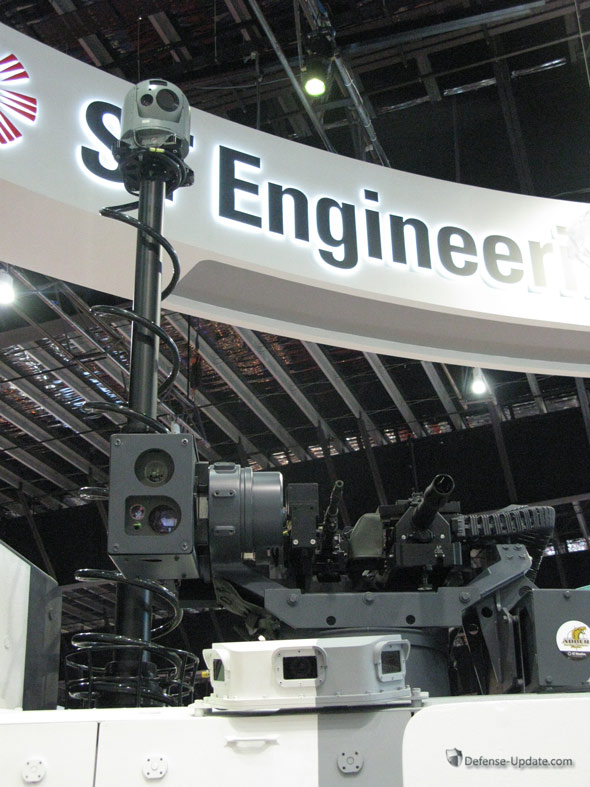
ST Kinetics is displaying the Reconnaissance, Surveillance and Target Acquisition (RSTA) variant of the Terrex at the land systems pavilion of the Singapore Airshow 2012. The vehicle is based on the operational Terrex, fitted with a number of new systems supporting intelligence gathering and target acquisition missions.
Photo: Tamir Eshel, Defense-Update
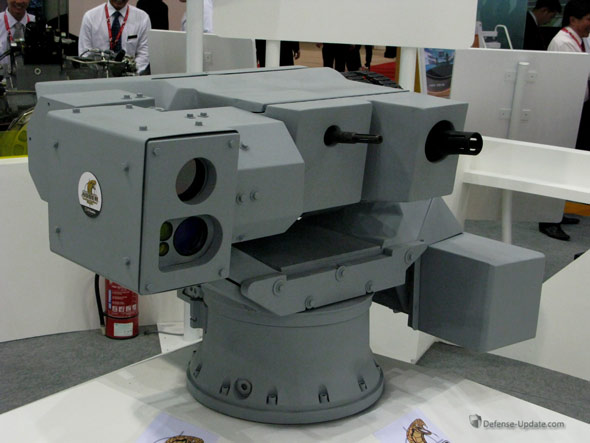
Most notable is the MINI-T, a stabilised electro-optical payload provided by STELOP. The payload is mounted on a telescopic mast, providing the vehicle an efficient capability to observe the area from concealed positions. The system is particularly suitable for operations in tropical environment, with the telescopic mast enabling the crew a look over the canopy and thermal imagers supporting operations in high humidity. The MINI-T packs a day camera, cooled thermal imager, a laser rangefinder and laser pointer in a stabilized 22kg payload, which includes all the supporting electronic equipment. The same ball can also accommodate a laser designator. These sensors enable the detection of human targets at a range of nine kilometers in daylight conditions or three kilometers at night.
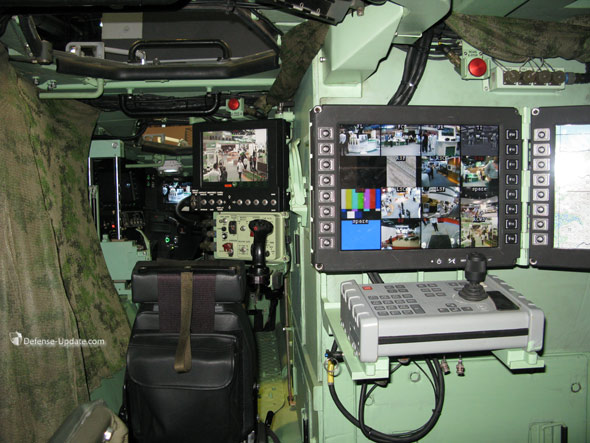
The vehicle will be equipped with the Skyblade 3 mini-unmanned aerial vehicle, providing top-down view of an extended area under surveillance. The imagery from the UAV is fed through the datalink and mission control system to the TERREX RSTA mission system, with imagery from the UAV payload, mast mounted sensors, remote weapon systems and panoramic vision systems all displayed and shared by the crew on multiple displays via the C4I supporting system. Other devices integrated on this technology demonstrator include panoramic cameras (viewed below) as well as threat warning sensors, providing missile and laser warning sensors for the crew.
This image of the TERREX RSTA shows an internal view of the system, depicting the driver (far forward), gunner (forward left) and observer positions. The tactical situation operated by the commander is located to the right. Photo: Tamir Eshel, Defense-Update
Another prominent feature is the ADDER remote weapon system. ADDER Represents a family of remotely controlled weapon systems developed by ST Kinetics, ranging from systems accommodating light and medium caliber weapons. A dual weapon station of this type has been integrated on the TERREX infantry carrier and a different variant is shown here on the RSTA variant.
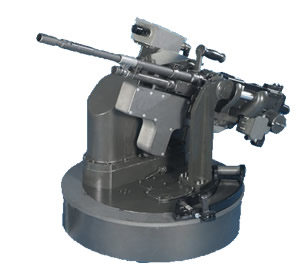
Another version of the ADDER RWS, depicting a more protected dual-weapon mount for naval use. Photo: Tamir Eshel, 

Data Link wins South Korean F-16 upgrade


  Data Link Solutions, a joint venture between Rockwell Collins and BAE Systems, has won a $5.5 million contract to provide multifunctional information distribution systems for South Korea's F-16 jets.
Data Link's MIDS-low volume terminal is an advanced Link-16 command, control, communications and intelligence system. It uses high-capacity, jam-resistant digital communication links for exchange of near real-time tactical data and voice information.
"This contract enables a critical military requirement for the (South Korean) air force F-16s to meet their data link network requirements," DLS Director Mike Beltrani said.
The terminals support key theater functions such as surveillance, identification, air control, weapons engagement coordination, and direction for all the services and allied forces, DLS said.
The system is used by the U.S. Navy, U.S. Air Force and U.S. Army platforms, as well as platforms used by the militaries of France, Italy, Germany and Spain.
The MIDS-LVT has two major line-replaceable units, the receiver-transmitter and the remote power supply. It can be used for a wide variety of airborne, ground and maritime applications, DLS said.
The U.S. Navy manages production of MIDS-LVT units which began in October 2001.
Work is being done in Wayne, N.J., and Cedar Rapids, Iowa. Deliveries to South Korea began last year and will continue up to 2014.
In November, South Korea issued a request for proposal for a major upgrade to upgrade 134 of its F-16s with active electronically scanned array radars.
South Korea's Defense Acquisition Program Administration issued the request for proposal to Northrop Grumman for its Scaleable Agile Beam Radar and to Raytheon for its Advanced Combat Radar.
Jim Hvizd, Raytheon's vice president of international business development, said South Korea's RFP is "the culmination of seven years of activity" developing its RACR from the APG-79 AESA installed on Boeing F/A-18E/F Super Hornet aircraft.
Northrop is the incumbent F-16 radar supplier, a report by FlightGlobal aviation Web site said. Northrop has been working on its SABR technology for five years.
Around 50 percent of the contract value will be in offset work back to South Korean businesses, FlightGlobal reported.
In early January, Yonhap news agency cited the U.S. 7th Air Force in reporting that the Air Force will deploy 12 F-16CM fighters to South Korea to maintain stability in the region.
Around 240 personnel from the 55th Expeditionary Fighter Squadron and their aircraft were to be stationed at a U.S. air base in Gunsan, 160 miles south of Seoul. The personnel and aircraft will be there for around three months, the Air Force said.

čtvrtek 26. ledna 2012

German firms announce couplings


   Krauss-Maffei Wegmann of Germany is strengthening its production of armored vehicles through the acquisition of an EDAG business unit.
Two other German companies recently reported the formation of a joint venture to further develop unmanned aerial systems.
The EDAG Group is a German automotive development specialist and KMW is eyeing its production branch for civilian-sector armored vehicle products.
"The extension of our numerous protection activities through the EDAG protection branch is a logical step and, with a view to the site in Mexico, a consistent continuation of our Central and South America strategy", said Frank Haun, president and chief executive officer of KMW.
EDAG's protection branch develops and integrates ballistic protection systems, including protection modules and complete protection kits as well as vehicle superstructure components.
It operates facilities in Ingolstadt, Germany, and in Mexico, which KMW will now take over.
Krauss-Maffei Wegmann, which has headquarters in Munich, is a major producer of military vehicles, including main battle tanks. With the acquisition of EDAG it strengthens and broadens its market offerings and position, including in Latin America, where KMW has supplied armored patrol vehicles to Brazil's armed forces.
Financial terms of the acquisition weren't disclosed.
Meanwhile, in Europe's aerospace sector, German companies Cassidian and Rheinmetall AG plan to establish a joint venture for further development of Rheinmetall Defense Electronics subsidiary's work on unmanned aerial systems.
Under the agreement, Cassidian will hold 51 percent of the joint venture's shares.
"As Europe's leading provider of Unmanned Aerial Systems, we see this as a logical step towards expanding our present UAS programs," said Cassidian Chief Executive Officer Stefan Zoller.
We can offer our global customers a full product range of customized solutions, including tactical UAS and UAS for medium- and high-altitude."
Added Klaus Eberhardt, chairman of the executive board of Rheinmetall AG, "First and foremost, our goal is to strengthen the Airborne Systems product unit in a sustained way, providing it with new opportunities for marketing its state-of-the-art products in years to come."
The companies said the joint venture would continue Rheinmetall's manufacturing of the KZO unmanned reconnaissance system and Heron UAS.

sobota 7. ledna 2012

Renault delivers gunfire detection systems


  French forces operating in Afghanistan have been supplied Slate acoustic sniper localization systems for integration with VAB armored personnel carriers.
Renault Trucks Defense reports it supplied 80 Slate kits to the French defense procurement agency DGA in late November after receiving an urgent operational requirement order from the agency.
The system is features an acoustic antenna for detecting gunfire -- produced by a 01dB-Metravib.
The Metravib is connected to the TOP 12.7 (Protector M151) remote control weapon system on the armored vehicle. The TOP is made by7 Kongsberg of Norway.
Renault said that when the unit detects a gunshot, crew of the VAB can automatically cue the vehicle's gun turret in the direction of where the gunshot originated and return fire.
Slate also provides vehicle crew with information on whether the gunshot came from a small- or medium-caliber weapon and stores the geographical information in a memory system.
The storage allows crew to engage an attacker with precision fire from the turret-mounted machine gun or grenade launcher even after the vehicle has changed position.
Renault said the Slate system could be connected to information and command systems for sharing of tactical information.
Renault delivered 80 of the systems to French forces.
Kongsberg Protech Systems, maker of the remote-controlled weapons system on the French army vehicles, also provides a variety of high-tech systems to militaries around the world for enhanced situational awareness and protection. Its Protector remote weapons station is currently used by 17 countries.
Renault Trucks Defense designs and manufactures a range of armored vehicles. The French army has more than 4,000 of its VABs in operation.
The VAB is a fully amphibious 4x4 or 4x6 armored personnel carrier or scout car. An air defense variant can be equipped with Mistral missiles. Depending on the variant, the vehicle can carry as many as 10 soldiers in addition to two crew members.
The VAB is 19.6 feet long, 8 feet wide and 6.7 feet high. It's powered by a six-cylinder, in-line water-cooled engine and has a maximum speed of about 57 mph.

neděle 11. prosince 2011

Elbit Systems Wins IDF Contract for a new Light Weapon Stations

Elbit Systems will deliver Lightweight Weapons Stations (LWS) under two contracts worth US$21 million, from the Israel Ministry of Defense (IMOD) and  to a European Army. Today the company reported an award of a contract valued at approximately $11 million by the Israel Ministry of Defense, for development and initial procurement, as part of an upgrade process of the Israel Defense Forces’ (IDF) lightweight weapons arsenal. These LWS will be delivered over a period of 18-month.
Elbit Systems Light Weapon Station (LWS)
Elbit Systems will develop the Light Weapon Station (LWS) to meet the IDF requirement for an affordable and compact light weapon station, mounting 7.62, 12.7mm machine guns or 40mm automatic grenade launchers. The LWS will eventually replace the current version of IDF weapon stations based on the heavier Samson RCWS. Photo: Elbit Systems
The IDF currently employ the ‘Katlanit’ based on Rafael’s Samson. Initially, the IDF required a lightweight RWS to augment the Merkava main battle tank, but this initiative was shelved for other priorities. Under the follow on initiative, the IDF was looking for a low weight, lower cost system to fit on a wider range of armored vehicles, including Armored Personnel Carriers (APCs) and Armored Fighting Vehicles (AFVs) such as the new Namer, all currently fitted with the Samson. A more compact and light mount will also be suitable for use on a wider range of armor protected vehicles, including patrol vehicles such as the Wolf (Zeev) used for security missions, armored HMMWV and even unmanned ground vehicles. Such a system will be able to improve the crew’s ability to perform area surveillance, observation, target acquisition and employ firepower in accurate and effective way, all under the vehicle’s armor protection. Elbit Systems and IMI, offering its new, lightweight Wave 400 design, both competed for this contract but Rafael preferred not to bid, despite having the ‘Samson Junior’ in hand.
The system developed at Elbit Systems was designed in a compact assembly, mounting light weapons from the 7.62mm machine gun, up to the 12.7mm heavy machine gun and 40mm automatic grenade launcher (AGL), an associated electro-optical payload and remote controls. As an overhead weapon system, the LWS can be fitted anywhere on the upper deck without penetrating the armor plates. Operated remotely with full control of aiming, firing, cocking and jam clearing, it can operate in stand alone mode or be integrated into the vehicle’s electronics and battle management systems, a potential advantage offering future opportunities for the company.
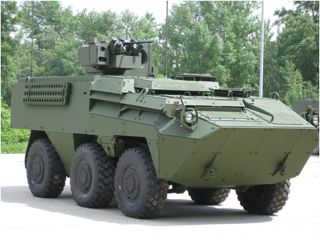
Elbit Systems ORCWS mounted the Austrian Pandur 6x6 built by Styer.
Elbit Systems Overhead Remotely Controlled Weapon Station (ORCWS) mounted the Austrian Pandur 6x6 built by Styer.
Elbit Systems also reported today receiving a contract valued approximately $10 million for the supply of 12.7mm LWS to an unnamed European army. The stations are to be installed onboard Pandur 6×6 vehicles and will be supplied over a period of one year. Pandur 6×6 vehicles are currently operational with Austria, Belgium and Slovenia. The later has taken the first 30 vehicles (local designation ‘Valuk’), out of 85 ordered. The Valuk family of vehicles include these infantry carriers, mortar vehicles (to be fitted with Elbit Systems’ Cardom 120mm mortars), ambulances and scout vehicles, fitted with a Samson 25mm overhead weapon station and Toplite observation system, both provided by another Israeli company – Rafael. Elbit Systems has provided a similar system for Pandur 6×6 of the Belgian Army, and has also delivered LWS armed with 12.7mm HMG.  The Austrian Army has also selected Elbit Systems’ LWS for its Light Armored Vehicles (LMV) made by Iveco.
Our new writer Tomasz Basarabowicz from Poland assisted in the preparation of this article.
čtvrtek 24. listopadu 2011

Austrian army to slash two thirds of its tanks to save money

    The Austrian army will sell, scrap or recycle two thirds of its armoured vehicles by late 2013, allowing it to save up to 15 million euros yearly, Defence Minister Norbert Darabos announced Wednesday.
"We are getting rid of cost-intensive equipment which represents an expensive burden for the army and which we no longer need," Darabos, who has been trying to push through army reforms, told a press conference.
The number of armoured vehicles, which has already seen cuts over the past four years, will thus shrink to 389 by the end of 2013, from a current 1,147.
Several models -- including more than 400 Saurers dating back to the 1960s -- will be scrapped entirely, while others will be recycled as spare parts for other vehicles.
Further models, like the more modern Leopard tanks, will meanwhile be put up for sale, and several governments and firms have already expressed interest, the defence ministry said.
The sales should help bring in 19 million euros ($25.5 million), although two million euros will have to go towards destroying ammunition.
Additionally, the army will save up to 15 million euros per year in maintenance thanks to the cuts, according to the ministry.
"We need more than ever to adapt our capabilities to realistic deployment scenarios," said Darabos.
Where Austria once stood with its back against the Iron Curtain, with the prospect of a conventional war with the Soviet bloc on its doorstep, now "we face cyber threats, terrorist threats: these are the challenges of the future," he noted.

Raytheon SDB II Warhead Exceeds Test Requirements

   The warhead for Raytheon's Small Diameter Bomb II performed at twice what was required during a series of recent tests. The test marked the first demonstration of an SDB II warhead built on a fully-automated production line.
SDB II is the world's first weapon capable of engaging fixed or moving targets around-the-clock in adverse weather conditions from a range of greater than 40 nautical miles (approximately 46 statute miles).
"SDB II is affordable because we designed it to be low cost, producible, and meet government specifications. Exceeding those requirements at no extra cost is good for the taxpayer and warfighter," said Harry Schulte, vice president of Raytheon Missile Systems' Air Warfare Systems.
"We are determined to keep SDB II on cost and ahead of schedule because the warfighter needs, but doesn't have, an air-launched weapon that can engage moving targets in adverse weather."
After building the test warheads on the production line, engineers put the warheads through an accelerated conditioning regime equivalent to 500 flight hours and 20 years of aging in a bunker, followed by live detonation testing.
"Using production-ready processes, the SDB II warhead is meeting or exceeding all requirements barely a year after contract award," said Tom White, Raytheon's SDB II program director.
"The Raytheon team is dedicated to giving all stakeholders the best value for their money, and most importantly, giving our warfighters a critical capability they don't have today."
SDB II's integrated tri-mode seeker fuses millimeter-wave (MMW) radar, uncooled imaging infrared (IIR) and semiactive laser sensors on a single gimbal, which enables the weapon to seek and destroy targets, despite weather conditions.
+ SDB II uses an uncooled tri-mode seeker to hit moving targets in all weather conditions.
+ SDB II program is on cost and ahead of schedule.

Australian Police to Trial Metal Storm MAUL

   Metal Storm is pleased to announce that two Australian Police Forces have formally requested an opportunity to trial the Metal Storm MAUL 12-gauge weapon system.
BREON Defence, the Asia Pacific TASER distributor and Metal Storm's exclusive distributor for law enforcement in Australia and New Zealand, has delivered the formal requests on police letterhead to the Company.
Metal Storm CEO, Dr Lee Finniear said that MAUL was creating a great deal of enquiry and requests for trials from around the world, however as an Australian Company getting the interest of the Australian Police is a very important step forward.
"Internationally MAUL continues to gather momentum even before we enter production", he said. "At present we have formal enquiries and/or requests for trial from 46 US domestic law enforcement agencies, 6 US Federal law enforcement agencies and 11 other international law enforcement agencies." he said. "However, as Australians we attach great importance to assisting our own police forces to obtain the benefit of our developments".
Director of BREON Defence, Mr George Hateley said he could see a very clear future for MAUL in Police operations.
"As a Director of BREON and a former member of the Victoria Police Special Operations Group (Anti-Terrorist Unit) I have a great deal of experience knowing what Tactical Special Operations and law enforcement officers need in their respective roles in 'High Risk' entries under warrant, and in the arrests of potential violent and or armed offenders," he said.
"When I saw MAUL I recognised it as an incredibly flexible non-lethal/lethal weapon when compared to what is currently available. We are 100% confident in our initial enquiries with specialist law enforcement units around Australia that the weapon will easily fit into the holistic weapons package and minimise what needs to be carried in the future in 'High Risk' tasks".
The Company recently announced it is collaborating with TASER International to integrate TASER capabilities into MAUL using the TASER XREP projectile and increase its capability for law enforcement operations.
The Company is currently undertaking a Rights Issue to raise capital. Part of the raising will be used to progress MAUL toward full production to satisfy the growing demand for the weapon.
Dr Finniear said, "Recent published market research states that the global non-lethal weapons market is expected to grow three-fold by 2020. Demand for MAUL is undeniable and getting this weapon into production is a top priority for the Company" he said. "In the short term we are focusing our resources onto MAUL to meet this growing demand for trials and the potential for near term deployments."

New Light Machine Gun Aims to 'SAW' Soldiers' Load

   Nearly 20 Soldiers participated in a two-week assessment of a prototype light machine gun to demonstrate its potential impact on mission effectiveness and to help engineers develop possible improvements to the weapon and its unique ammunition. The evaluation sought the warfighter's perspective after enduring a series of strenuous combat performance drills with the weapon.
It had taken six years to get from a concept to a fully functioning weapon that was ready for evaluation, but Kori Phillips, a project management engineer in the Joint Service Small Arms Program, or JSSAP, said it was well worth the wait.
"This is exactly what we have been waiting for," said Phillips. "This is what we need to move forward."
The Soldiers' feedback will be used to influence the user community to develop a Capability Development Document. A CDD is required before the system can transition to a program of record and enter the Engineering and Manufacturing Development phase of the acquisition life cycle.
This would be the next step needed for the program to move forward toward an eventual fielding of the weapon to Soldiers in the field.
The light machine gun is part of the Lightweight Small Arms Technologies, or LSAT, program, which is managed by the JSSAP, part of the Army's Armament Research, Development and Engineering Center, or ARDEC, at Picatinny Arsenal, N.J.
The LMG is a gas-operated, cased telescoped light machine gun. It is air-cooled and belt fed with selectable semi-automatic and fully automatic fire and fires from the open-bolt position. Its rate of fire is approximately 650 rounds per minute.
The JSSAP team hopes that the LMG will eventually replace the M249 Squad Automatic Weapon, knows as a SAW, as the standard issue machine gun used by Soldiers in combat zones.
Getting To Know The Weapon
The machine guns and their operators were tested through automatic rifleman tasks and operational scenarios.
The purpose was to assess how the lighter machine gun affects the Soldiers' ability to effectively engage targets from various firing positions after completing tasks that induced physical stress and an elevated heart rate.
The weapons were also evaluated on their suitability regarding portability, safety, compatibility with Soldier equipment, durability in challenging environments, ease of use, and impact on Soldier mobility.
"We ran Soldiers through with both weapon systems and timed them to look at how much faster they could complete the course with the lighter weapon and to gain subjective feedback on mobility and portability issues while they negotiated the obstacles," said Maj. Matthew Bowler, a military advisor to the small arms program.
Immediately after each event, the Soldiers filled out surveys where they offered opinions about how they felt physically, and any issues or malfunctions they experienced with either weapon or its ammunition. They could also include any positive feedback.
On the first day of the second week, the Soldiers marched six miles in full combat gear, including body armor, a 50-pound rucksack and a basic load of ammunition for their respective weapons. Half the Soldiers carried the SAW and the other half carried the LMG.
After the road march, the Soldiers immediately started firing their weapons to measure the effects of muscle fatigue and stress while firing.
Sgt. Brandon Vega, an infantryman with the 2/29 Infantry Battalion, saw an increase in his accuracy when firing the LSAT after the march compared to the SAW.
"The first six round bursts were within the size of a quarter," Vega said. "Then I got three on top of one so I was real impressed with that."
Vega added that, using the SAW, he has yet to achieve the same level of accuracy.
According to a study conducted in 2005, the average fighting load for the SAW gunner is 79 pounds. That is nearly twice the weight a Soldier should carry, according to Army doctrine.
"The Soldier carries too much weight so anything we can do to reduce Soldier load increases the Soldier's effectiveness, his capability on the battlefield and his survivability," said Bowler.
The weight reduction provided by the LMG would have a significant effect on the SAW gunner, the most heavily burdened Soldier in the squad.
With a basic load of 1,000 rounds, the light machine gun and its cased telescoped ammunition is 20.4 pounds lighter than a traditional SAW with the same amount of standard, brass-cased ammunition.
During the assessment, more than 25,000 rounds were fired from eight prototype LMGs. The suggested rate of fire for machine guns is three to five round bursts whenever possible, eight to ten round bursts at the most. This gives the gunner time to readjust his aim and helps keep the barrel from overheating as quickly.
A high rate of fire increases the possibility of a "cook off." Cook off occurs when the propellant is unintentionally ignited by the heat in the weapon chamber, firing a round unexpectedly and causing a significant safety hazard.
Because of the design of the chamber, the LMG is very unlikely to experience a cook off, Phillips said. Technical tests showed that more than 250 rounds could be fired without a risk of cook off. The M249 SAW has been known to cook off at 220 rounds under certain circumstances.
Other Assessments
In another assessment of shooting while under physical stress, Soldiers wore body armor and sprinted 200 yards with their weapons and a basic load of ammunition, then rapidly engaged close-range targets from the standing position. Again, they performed this task with both weapons. Many Soldiers saw an improvement in their overall time with the lighter weapon.
"Today we ran with the LSAT and with the SAW," said Cpl. Nickolaus Hammack, one of the military police Soldiers participating in the assessment. "Both were pretty trying but the SAW hands down is way heavier. Especially going up a hill, you feel the weight on you. (The) LSAT is a lot lighter weapon. It really is a joy to have."
The third week of assessment involved Soldiers of the 75th Ranger Regiment. They used two of the LMGs as part of a squad maneuver live-fire exercise to determine how the attributes of the new weapon system would impact squad effectiveness.
The exercise was conducted in an urban setting where the Soldiers used the weapon for suppressive fire and for room-clearing.
The Rangers said they liked the semi-auto feature that made the LMG a much more viable weapon for room-clearing than the SAW.
Additionally, one Ranger commented that the weight of the LMG as a system was "noticeably better" than that of the Mk 46 variant of the SAW that they currently use, because of the significantly lighter ammunition that dramatically increased his mobility while maneuvering as part of the squad.
Future Of The Light Machine Gun
Overall, the Soldiers' comments were positive and they overwhelmingly preferred the LMG to the SAW. They were impressed by the weapon's light weight, decreased felt recoil, and related increase in accuracy and better control.
The Soldiers' input could lead to design changes to any final product. However, no decision has been made on whether the LMG will eventually be fielded.
Spc. Brandon Smith, an infantryman, spent two weeks comparing the weapons.
"I could see a whole squad carrying it (the LMG)," he said. "You would own the battlefield."