neděle 11. prosince 2011

Elbit Systems Wins IDF Contract for a new Light Weapon Stations

Elbit Systems will deliver Lightweight Weapons Stations (LWS) under two contracts worth US$21 million, from the Israel Ministry of Defense (IMOD) and  to a European Army. Today the company reported an award of a contract valued at approximately $11 million by the Israel Ministry of Defense, for development and initial procurement, as part of an upgrade process of the Israel Defense Forces’ (IDF) lightweight weapons arsenal. These LWS will be delivered over a period of 18-month.
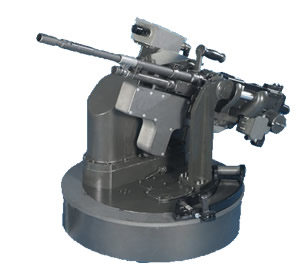
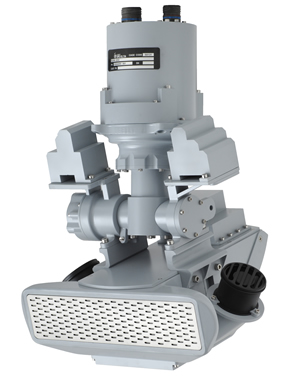
Elbit Systems Light Weapon Station (LWS)
Elbit Systems will develop the Light Weapon Station (LWS) to meet the IDF requirement for an affordable and compact light weapon station, mounting 7.62, 12.7mm machine guns or 40mm automatic grenade launchers. The LWS will eventually replace the current version of IDF weapon stations based on the heavier Samson RCWS. Photo: Elbit Systems
The IDF currently employ the ‘Katlanit’ based on Rafael’s Samson. Initially, the IDF required a lightweight RWS to augment the Merkava main battle tank, but this initiative was shelved for other priorities. Under the follow on initiative, the IDF was looking for a low weight, lower cost system to fit on a wider range of armored vehicles, including Armored Personnel Carriers (APCs) and Armored Fighting Vehicles (AFVs) such as the new Namer, all currently fitted with the Samson. A more compact and light mount will also be suitable for use on a wider range of armor protected vehicles, including patrol vehicles such as the Wolf (Zeev) used for security missions, armored HMMWV and even unmanned ground vehicles. Such a system will be able to improve the crew’s ability to perform area surveillance, observation, target acquisition and employ firepower in accurate and effective way, all under the vehicle’s armor protection. Elbit Systems and IMI, offering its new, lightweight Wave 400 design, both competed for this contract but Rafael preferred not to bid, despite having the ‘Samson Junior’ in hand.
The system developed at Elbit Systems was designed in a compact assembly, mounting light weapons from the 7.62mm machine gun, up to the 12.7mm heavy machine gun and 40mm automatic grenade launcher (AGL), an associated electro-optical payload and remote controls. As an overhead weapon system, the LWS can be fitted anywhere on the upper deck without penetrating the armor plates. Operated remotely with full control of aiming, firing, cocking and jam clearing, it can operate in stand alone mode or be integrated into the vehicle’s electronics and battle management systems, a potential advantage offering future opportunities for the company.
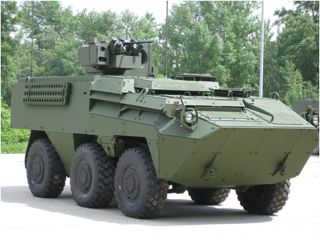
Elbit Systems ORCWS mounted the Austrian Pandur 6x6 built by Styer.
Elbit Systems Overhead Remotely Controlled Weapon Station (ORCWS) mounted the Austrian Pandur 6x6 built by Styer.
Elbit Systems also reported today receiving a contract valued approximately $10 million for the supply of 12.7mm LWS to an unnamed European army. The stations are to be installed onboard Pandur 6×6 vehicles and will be supplied over a period of one year. Pandur 6×6 vehicles are currently operational with Austria, Belgium and Slovenia. The later has taken the first 30 vehicles (local designation ‘Valuk’), out of 85 ordered. The Valuk family of vehicles include these infantry carriers, mortar vehicles (to be fitted with Elbit Systems’ Cardom 120mm mortars), ambulances and scout vehicles, fitted with a Samson 25mm overhead weapon station and Toplite observation system, both provided by another Israeli company – Rafael. Elbit Systems has provided a similar system for Pandur 6×6 of the Belgian Army, and has also delivered LWS armed with 12.7mm HMG.  The Austrian Army has also selected Elbit Systems’ LWS for its Light Armored Vehicles (LMV) made by Iveco.
Our new writer Tomasz Basarabowicz from Poland assisted in the preparation of this article.

CICADA Micro-Drones Open New Opportunities for Future Covert Surveillance

CICADA is a concept for a low-cost, GPS-guided, micro disposable air vehicle that can be deployed in large numbers to “seed” an area with miniature electronic payloads. These payloads could be interconnected to form an ad-hoc, self-configuring network. Communication nodes, sensors, or effectors can then be placed in a programmable geometric pattern in hostile territory without directly over-flying those regions or exposing human agents on the ground.
In September 2011 the Naval Research Laboratory (NRL) successfully completed flight tests demonstrating how these miniature, disposable aerial vehicles can be used to emplace covert sensors on the ground. The ‘Autonomous Deployment Demonstration’ (ADD) conducted in September 2011 at the Yuma Proving Grounds in Arizona spanned over a series of eight balloon-drops at altitudes of up to 57,000 ft, delivering an unmanned ‘mothership’ UAV carrying two Close-In Covert Autonomous Disposable Aircraft (CICADA) vehicles on sensor-emplacement missions. The sensors were deployed across a distance of 30 nautical miles (55km) dispersing to assigned locations within 3 meter (15 feet) of their intended landing locations.
CICADA Mk3
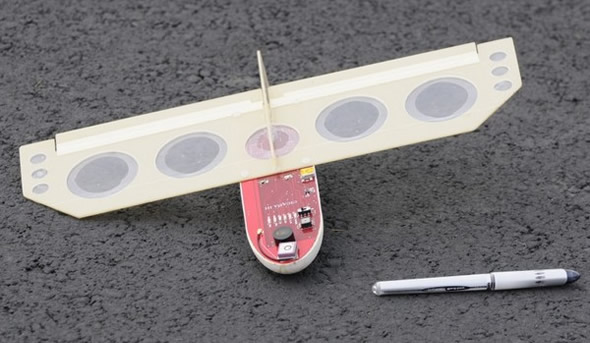
The airframe of CICADA Mark III is the printed circuit board serving the autopilot. This novel construction method significantly reduces assembly time, minimizes wiring requirements, and enables the manufacture of low-cost and rugged micro air vehicles. The airframe shape is easily scaled to accommodate various payload sizes and potential acoustic, magnetic, chemical/biological and SIGINT sensors. Photo: NRL
CICADA is a small, disposable unmanned air vehicles launched from aircraft, balloons or precision-guided munitions. On a surveillance mission these mini drones are equipped with sensor payloads and dispersed in selectable patterns around designated areas. Essentially a flying circuit board, CICADA has an extremely high packing factor and a very low per-unit cost. Eighteen vehicles can be contained in a six-inch cube. The vehicle is inherently stable in glide, with a glide ratio of 3.5
“The CICADA is dropped from another airborne platform, flies to a single waypoint, and then enters an orbit. It descends in that orbit until it reaches the ground.” says Chris Bovais, aeronautical engineer and flight test coordinator, NRL Vehicle Research Section. “Many remote sensors are currently hand emplaced,” said Bovais. “The CICADA allows for the low-cost delivery of multiple precision-located sensors without placing the warfighter in harm’s way.”
The NRL developed CICADA Mark III UAV is a glider generating no acoustic or radar signature in flight. The airframe is basically the printed circuit board serving the autopilot. This novel construction method significantly reduces assembly time, minimizes wiring requirements, and enables the manufacture of low-cost and rugged micro air vehicles. The airframe shape is easily scaled to accommodate various payload sizes and potential acoustic, magnetic, chemical/biological and SIGINT sensors. Unique to this construction technique, additional electronic payloads can be inserted into the system by updating the printed circuit board artwork and ‘re-winging’ the aircraft. CICADA uses a custom autopilot and a two-axis gyro developed at the NRL Vehicle Research Section. The flight controller also included a custom NRL algorithm that accurately estimated wind speed and magnitude, despite having no air data sensors onboard, delivering accurate navigation with minimal sensors and control surfaces.
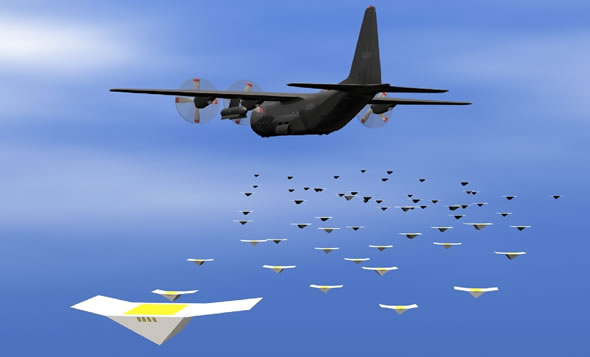
In development since 2006, CICADA offers a new method of deploying covert surveillance sensors from aircraft, unmanned vehicles, balloons or precision-guided munitions. An example of such dispersion concept shows scattering of disposable micro-UAV sensors from underwing pods carried by a C-130 hercules. Illustration: NRL

Iran Displays Captured RQ-170 Stealth Drone

On December 8 Tehran came out open displaying footage of the captured RQ-170 drone which seems in pristine condition. Islamic Revolutionary Guard Corps’ Aerospace Forces Brigadier General Amir Ali Hajizadeh inspecting his newly gained trophy. The drone shown on Iran television appears to be in remarkably good condition ‘inconsistent with an uncontrolled landing’, the New York Times said. In fact, Danger Room suggest the drone shown by the Iranians may be a fake. Iran explains the were able to capture the drone almost intact as it was lured into a ‘trap’ set by their electronic combat forces.
Although the drone was reportedly shot down by Iran’s air defense, its upper surface seems to be intact except for few dents to the leading edge. More extensive damage may be at the bottom. As it is covered by propaganda billboards and camouflage nets, it may hint about more extensive damage caused by hard landing. Iranian sources claim that their electronic combat units took part in the incident, assumingly intercepting, ‘hijacking’ or otherwise disrupting the drone’s control link in a way that denied it from returning to Afghanistan.

Noteworthy details in this video are the air intake grill, designed to mask radar echoes from the turbine surface. Also notable are the masking tape used to cover seams wing-body blending, and various locations on the top of the wing. Aerodynamic surfaces are placed throughout the wing trailing edge, with more elements extracted from the surface (spoilers?). The strange bulges over the wings are sealed, and may have access from below. According to Iranian published data, the drones wing span is 25 meter, 4.5 m’ long and two meters high.

Pentagon Spends US$4 Billion on the Fifth Production Batch of 30 F-35s

The US Department of Defense awarded Lockheed Martin four billion US$ for the procurement of 30 F-35s as part of the fifth F-35 Low Rate Initial Production batch. The Air Force will get 21 F-35As for US$2.644 billion ($126 million per aircraft), the Navy will pay $937 million to receive six F-35Cs (over $156 million per aircraft) and the Marine Corps will shelve 426 million to get 3 Short Take Off Vertical Landing (STOVL) F-35Bs at a cost of $142 million per aircraft.
The original LRIP V plan was for 47 aircraft but the Australians have pushed back their orders, with the Pentagon reducing the lot to 35 aircraft back in April 2011. The current level of 30 aircraft reflects a further of five aircraft, saving over $770 million to pay for cost overruns incurred through program delays and design changes. For the first time in the program, LRIP V represents a slow down in the F-35 production plan, compared to LRIP IV which included 32 aircraft.
According to Stephen Trimble at Flight Global the next LRIP-VI order, scheduled for award in few months, will also be slashed by more than half from the 80 aircraft originally planned only two years ago, to 38 aircraft.
Army Gen. Martin Dempsey, chairman of the Joint Chiefs of Staff, said today the F-35 may have to be stretched out. Apart from escalating costs pressure on the F-35 is also coming from Europe’s financial troubles that might undercut those partners on the eastern side of the Atlantic. The Air Force chief of staff, Gen. Norton Schwartz, said his service would do everything it can to protect the F-35, the Long Range Strike bomber and the KC-46 tanker program. “There are three programs which we will sustain, and that is the F-35 at an appropriate level, the new bomber will certainly begin development, and then we will bring the tanker on,” Schwartz said. (Navy Times)
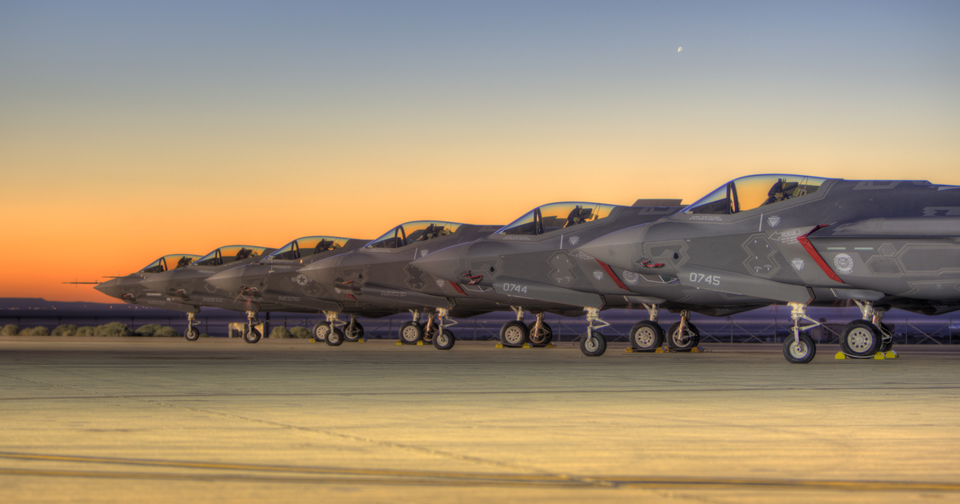
F-35 test aircraft at Edwards AFB
All six F-35s currently at Edwards AFB, Calif. for flight test: AF-1, AF-2, AF-3, AF-4, AF-6 and AF-7 Photo: Lockheed Martin

Challenging Times for UAV Operations over Pakistan

In a step further deteriorating relations between Pakistan and NATO, Islamabad announced today its air defense forces will shoot down any aircraft, manned or unmanned, penetrating its borders. Pakistan’s tougher  stand regarding foreign operations within its airspace has changed dramatically after U.S. helicopters fired at Pakistani troops along the border with Afghanistan November 26, 2011, killing 24 soldiers. “Any object entering into our airspace, including US drones, will be treated as hostile and be shot down,” a senior unnamed Pakistani military official was quoted as saying by NBC News. Following the incident Pakistan has shut down all NATO supply routes crossing its borders and directed the U.S. to leave the Shamsi airfield in Balochistan operated by the CIA in support of drone attacks in the area. All US have left the base by Saturday December 10, Pakistani sources confirmed.
Following the air strike, army chief Gen Ashfaq Parvez Kayani issued a communique that gave troops in the field full liberty to respond to any future attacks without consulting their superiors. Kayani issued multiple directives since the November 26 attack, including orders to shoot down US drones, senior military officials said.
US sources confirmed that drones have performed over 300 attacks inside Pakistan in recent years, in pursuit of Al Qaeda and Taliban supporters. Pakistani air defense units have deployed along the Afghan border and upgraded their alert. These attacks culminated in 2011, with the attack on Osama Bin Laden hiding place in Abbottabad Pakistan that followed by an extensive campaign against suspected terror supporters and operatives in Pakistan north-west frontier – Waziristan.
The Pakistani Air Force maintains mixed assets of air defense from European and Chinese origin. AMong these are Chinese HQ-9 and HQ-2 (Chinese versions, roughly equivalents to S-300 and SA-2 ), Medium and short range missiles include the Crotale and Spada 2000. These air defense systems are normally deployed in defense of strategic sites like air bases, military ports and nuclear facilities. These sites are normally protected by air defense artillery, including Oerlikon GDF-005 35mm twin-cannons (partly enhanced with AHEAD systems) and Bofors 40mm guns.
Very Short Range Air defense (VSHORAD) assets are presumably the systems newly deployed in the Afghan border area, include various types of locally built SA-7 derivatives called Anza and French Mistral, both covering ranges up to six kilometers, as well as the U.S. Stinger and Swedish RBS-70 laser-beam-riding missiles effective at up to 8 km range. Given the autonomous nature of these systems, small teams operating the missiles can be deployed with many units throughout the area, to rapidly fill the perceived air defense capability gap.
While the US have faced VSHORAD missile threats by missiles obtained by Afghanistan’s Taliban, given early warning and potential threat of more sophisticated sensors and other air defense assets, including the Erieye Airborne Early Warning systems, JF-7 and F-16 air defense fighters, turning the airspace over Waziristan and Southern Afghanistan into a ‘contested access’ airspace for aircraft, helicopters and UAVs.

úterý 6. prosince 2011

Raytheon Acquires Cybersecurity Firm Pikewerks

   Raytheon has acquired Pikewerks Corporation, a privately held company, to further extend Raytheon's capabilities to defend against sophisticated cybersecurity threats facing customers in the intelligence community, Department of Defense and commercial organizations. Terms of the transaction were not disclosed.
The transaction will not materially impact Raytheon's total company sales or earnings per share for the fourth quarter of 2011 or fiscal year 2012.
Pikewerks enhances Raytheon's comprehensive cybersecurity offerings, including a range of analysis and investigation capabilities with particular emphasis on insider threat protection, software protection and forensics.
Two high-demand Pikewerks products are Electronic Armor, an anti-exploitation software tool that protects executable files; and Second Look, a software capability for live, in-memory forensic analysis of operating systems.
Pikewerks brings one of the industry's largest repositories of kernel-level engineering talent on the Linux Operating System.
"Like Raytheon, Pikewerks is built on the commitment to undertake the hardest problems and apply creativity and innovation to push the limits of technology," said Lynn Dugle, president of Raytheon's Intelligence and Information Systems business.
"Developers at Pikewerks are experts who have taken technology from concept to deployment, and we are excited to welcome them as members of our innovative Raytheon team."
Pikewerks is based in Madison, Ala., with offices in Alexandria, Va., Seattle and San Antonio. Pikewerks' founder and President Sandy Ring, and CEO Michael Ring, will remain with the company.

Lockheed Martin Awarded Contracts For Marine Corps Targeting System

   Lockheed Martin received two contracts totaling $30.6 million from the Naval Surface Warfare Center for the Target Sight System (TSS), the fire control system for the U.S. Marine Corps' AH-1Z Cobra attack helicopter.
These contracts will provide spare units and parts as well as program support for the AH-1Z fleet. The Naval Surface Warfare Center awarded the initial TSS production contract in March 2008 and follow-on production contracts in June 2010 and September 2011.
Lockheed Martin delivered the first TSS in June 2009, and recently began early delivery of follow-on production units. Production is expected to continue through 2018. TSS is produced at facilities in Ocala and Orlando, Fla.
"TSS provides positive combat identification at safe standoff ranges," said Joseph Butera, senior program manager of airborne systems in Lockheed Martin's Missiles and Fire Control business.
"The system allows AH-1Z aviators to confidently engage the threat and return safely to base."
TSS integrates state-of-the-art sensors to provide aviators with superior imagery through a highly stabilized sensor suite, specifically tailored to the AH-1Z platform. The suite includes a laser designator, color TV camera and a third-generation, mid-wave, forward-looking infrared sensor with advanced image processing.
TSS is one of several high-performance stabilized targeting systems designed, manufactured, tested and supported by Lockheed Martin.
The company's fielded solutions for fixed- and rotary-wing aircraft include Modernized Target Acquisition Designation Sight/Pilot Night Vision Sensor for the U.S. Army, Sniper Advanced Targeting Pod for the U.S. Air Force and the AN/AAQ-39 targeting system for the U.S. Air Force Special Operations Command.

Northrop Grumman to Provide Combat Electromagnetic Environment Simulator for Air Force E-3 AWACS

   Northrop Grumman has been awarded a contract to provide a Combat Electromagnetic Environment Simulator (CEESIM) system to support maintenance of the U.S. Air Force E-3 Airborne Warning and Control System (AWACS) Electronic Support Measures Operational Computer Program software.
The contract was awarded by Defense Microelectronics Activity (DMEA). Northrop Grumman will deliver the CEESIM to Tinker Air Force Base Avionics Integration Support Facility (AISF), located in Oklahoma City, Okla.
The CEESIM provides navigation and pulse data generated from customized scenarios. It enables ASIF software engineers to model a real-world environment and to test software changes by injecting pulses into the avionics hardware.
"The flexibility of the AWACS CEESIM system allows for adaptation to a wide variety of both system-under-test and existing laboratory external control interfaces," said Joe Downie, president of Northrop Grumman's Amherst Systems business unit.
"This flexibility provides a cost-effective transition from the existing simulator to a state-of-the-art, supportable, modern simulator capability, in support of fifth-generation electronic warfare systems."
The AWACS CEESIM system will replace an Advanced Multiple Environment Simulator (AMES) system that has been operating at Tinker Air Force Base for 14 years.
The CEESIM replacement unit allows automatic conversion of legacy AMES emitter files to CEESIM emitter files for seamless reuse of AISF threat data and test scenarios.
The simulator also demonstrates the CEESIM versatility allowing for direct stimulation using radio frequency, intermediate frequency and digital outputs.
DMEA is a Department of Defense applied engineering facility charged with keeping microelectronics components in our military systems operational and technologically current.
DMEA works in cooperation with both defense prime contractors and the commercial semiconductor industry to ensure that the full range of military systems, developed over 40 years, are supportable and operationally ready to perform their mission.

Kratos Receives $2.4 Million Contract to Support International Missile Defense Systems

   Kratos Defense and Security Solutions has announced that its Herley Industries, Inc. subsidiary has been awarded a $2.4 million contract award in support of certain international missile defense efforts.
Herley will provide complex Integrated Microwave Assemblies (IMAs) to an international defense customer to be used in the ground stations of critical missile defense systems. No additional information is being provided due to customer and other sensitivities.
Richard F. Poirier, President of Herley, noted, "We are extremely pleased to see the continued growth and utilization of Herley technology and components in systems used by both the U.S. military and by our international allies.
"This work will be performed in our Israel operation and my congratulations go to Yonah Adelman, General Manager, and the entire Herley Israel team."
Herley Industries, Inc., a Kratos Defense and Security Solutions Company, is a leader in the design, development and manufacture of microwave technology solutions for the defense, aerospace and medical industries worldwide.
Based in Woburn, MA, Herley has seven manufacturing locations and approximately 1000 employees. Additional information about the company can be found on the Internet at

U.S. Navy examines undersea blast impact

   The U.S. Navy has ordered a $4.6 million investigation to analyze the effect of such an underwater blast on ships and submersibles within range.
Research over the years has concentrated on the dramatic and destructive impact of the water on vessels in the range of an underwater blast, which can often be deadlier than effects of an explosion on the surface or land but largely unpredictable.
The new research by Alion Science and Technology, an employee-owned technology solutions company, will analyze survivability and response of ships and submersibles to a explosion. The research will likely have global implications and also open new opportunities for Alion, other defense-related businesses and the U.S. military.
Alion's brief under the U.S. Navy contract will focus on the effects of underwater explosions, also called UNDEX, on the navy's platforms. The company says its experts will examine submarines, surface ships and associated platforms for the Naval Surface Warfare Center Carderock Division's Survivability and Weapons Effect Department.
"UNDEX incidents pose a different threat to Navy vessels than above-water explosions because of the pressure shock wave generated by a blast below the surface," explained J. J. Waickwicz, Alion's senior vice president and manager of the company's design, engineering and technology group.
"By providing the Navy with UNDEX engineering support, Alion is enabling leaders to conduct physical security assessments of the naval fleet for survivability and long-term performance, helping to extend the fleet's life cycle," Waickwicz said.
Alion will provide engineering and technical support for UNDEX testing, shock qualification and ship survivability programs.
Alion will also develop and validate algorithms for predicting the response of test vehicles, scale models and submarines and surface ships due to UNDEX events and it will develop and validate what it calls "novel" approaches for increasing the survivability of hull structure, systems and equipment in the UNDEX response environment. The contract is to last to September 2014.
The Naval Sea Systems Command's SeaPort Enhanced Multiple Award Contract provides support for U.S. Navy systems that range from weapons to fleet readiness and homeland security to logistics.
The contract supports the Navy Systems Commands, the Office of Naval Research, the U.S. Marine Corps and the Defense Threat Reduction Agency.
Alion has headquarters in McLean, Va., but says it has skilled employee-owners at offices, laboratories and customer sites worldwide.
Questions about the impact of undersea explosions have bedeviled defense scientists for some time. The effects of an underwater explosion can depend on a number of things, including distance from the explosion, the energy of the explosion, the depth of the explosion and water depth.
Although U.S. and other nations' nuclear tests monitored the impact of undersea explosions at varying depths, the impact on ships within the range on an explosion is an ongoing study. An undersea blast can create huge walls of water and bubbles filled with high-temperature air and other dramatic changes in the ocean.
The resulting shock waves can deliver devastating damage to vessels in the vicinity and decimate marine life.

Israel fears F-35 delivery will be delayed

   Israeli military planners say they are increasingly worried that problems in Lockheed Martin's F-35 Joint Strike Fighter program will mean that delivery of 20 of the stealthy jets ordered in October 2010 for $2.75 billion will be delayed.
If the delivery timetable is pushed back to later than 2017, senior military officers say the Israeli air force could consider acquiring new Boeing F-15 Eagles or Lockheed F-16 Fighting Falcons to fill the gap.
At present, the first of the 20 F-35s -- enough for one squadron -- is scheduled to arrive in Israel in 2015 with delivery completion in 2016. Pilots are to undergo training with the U.S. Air Force starting in 2014.
Until a few weeks ago, Israeli officials were confident that the first JSF squadron would be delivered on time, despite problems that have delayed the project for at least three years.
This optimism flew in the face of the technical setbacks that have plagued the development of what is billed as the world's most advanced fighter and even suggestions in Congress the high-profile project be scrapped because of massive cost overruns.
That confidence was undermined after the Pentagon's director of the F-35 program, U.S. Navy Vice Adm. David Venlet, urged slowing production because of cracks and "hot spots" that are showing up during fatigue testing and analysis.
"The analyzed hot spots that have arisen in the last 12 months or so in the program have surprised us at the amount of change and the cost," Venlet told the Web publication AOL Defense.
"Most of them are little ones. But when you bundle them, all up and package them, and look at where they are in the airplane and how hard they are to get at after you buy the jet, the cost burden of that is what sucks the wind out of your lungs," he said.
"I believe it's wise to sort of temper production for a while here, until we get some of these heavy years of learning under our belt and get that managed right."
The Israeli Defense Ministry has budgeted the purchase of more F-35s for a second squadron under the military's new multiyear plan that begins in early 2012.
Ultimately, the air force wants three F-35 squadrons to form the spearhead of its strike force -- some 75 aircraft. The Pentagon has already approved the sale to Israel of 55 of the single-engine jets at dates yet unspecified.
The Israelis say they need the F-35 to maintain their long-held air superiority in the Middle East, and in a wider context, the Jewish state's technological edge over its regional adversaries, Iran in particular.
Israel's main problem is that senior U.S. air force officers said in testimony before Congress in November that the F-35's development problems mean it's not likely to become operational with U.S. forces until 2018 -- two years later than planned.
Aviation Week reported recently that the U.S. Air Force plans to upgrade more than 300 Lockheed Martin F-16 fighters and probably some Boeing F-15s as well to fill the operational gap caused by the F-35 delays.
Despite the Israeli Defense Ministry's public position that procurement plans won't be affected by the F-35 delays, senior officers say additional delays could lead to the acquisition of new-model F-15s and F-16s to maintain Israel's qualitative edge in the air until the JSFs do actually arrive.
Boeing unveiled the F-15SE Silent Eagle in March 2010. It reportedly has a stealth capability that can evade radars carried by enemy aircraft but not ground-based radar systems.
The Israeli air force currently operates 25 customized F-15I -- for Israel -- Ra'am aircraft, and 101 F-16I Sufa jets that form its strategic spearhead and would be the squadrons deployed in any strike against Iran.
The F-15I has the longest range in the Israeli air force.
The Israelis paid close attention when Boeing launched the F-15SE in July 2010 at its St. Louis headquarters.
Another problem for the Israelis is the mounting cost of the F-35.
When Israel bought into the JSF program in 2002, the price tag was $69 million per aircraft. But that's constantly rising and could go as high as $150 million because of cost overruns.
The F-15SE reportedly costs around $100 million per aircraft.

Russia sends ship-killer missiles to Syria

   Russia, a key backer of the beleaguered regime of Syrian President Bashar al-Assad, is reported to have delivered supersonic Yakhont SS-N-26 anti-ship cruise missiles to Damascus despite calls for a U.N. arms embargo on the regime.
The Russian Interfax news agency quoted an unidentified military source in Moscow as saying the 2007 contract, which reportedly involved at least two coastal-defense Bastion anti-ship systems with 72 Yakhonts, "was completely fulfilled, almost ahead of time."
The contract is worth an estimated $300 million.
Interfax noted that "this weapon allows coverage of the entire coastline of Syria from possible attacks from the sea."
It isn't known when the delivery was made. But Syria's acquisition of the Yakhont, which Russia calls the P-800, has caused considerable alarm in Israel.
The SS-N-26, with a range of 190 miles and a maximum speed of 1,900 miles an hour, carries a warhead of 440 pounds of high explosive, enough to sink a large warship.
The weapon's nearest U.S. counterparts, Raytheon's BGM-109 Tomahawk and Boeing's AGM-84 Harpoon, are subsonic. The best French equivalent, MBDA's MM-40 Exocet, only has a range of 45 miles.
The Russian delivery was carried out as Assad battles for survival against a 9-month-old uprising to topple his dictatorial regime in which his security forces have killed, by U.N. count, at least 4,000 people since mid-March.
While international pressure against the regime has steadily mounted as the bloodletting goes on, with some 950 people killed in November alone, Moscow has stood by its ally in Damascus.
Russian Foreign Minister Sergei Lavrov last week rejected U.N. calls for an arms embargo on Syria on charges of committing crimes against humanity. Lavrov said that a similar move against Libya had favored rebels opposed to Moammar Gadhafi, who toppled and killed him in a civil war.
Moscow has had close ties with Damascus and has been one of its main arms suppliers, as it was during the Soviet era. Syria is the largest buyer of Russian weapons in the Middle East. Moscow has arms contracts with Damascus worth at least $3 billion-$5 billion, the Russian RIA Novosti news agency reported.
The Yakhonts are likely to be deployed to protect a planned Russian naval base at the Syrian port of Tartous in the eastern Mediterranean. Russia has said it is sending the missile cruiser Admiral Kuznetsov and escort vessels to visit Tartous during an upcoming two-month Mediterranean tour.
That follows the deployment of the U.S. Navy's latest aircraft carrier, the USS George H.W. Bush, off the Syrian coast in recent days, and underlines Moscow's commitment to Syria.
The Tartous base, currently under construction by 600 Russian technicians, will be Russia's only military foothold in the region and has also caused consternation in Israel.
The Israelis say some of the Yakhonts could end up in the hands of Hezbollah, Iran's main proxy in Lebanon and a key Syrian ally.
While Middle East security experts say they doubt that, given the need to protect the Russians' base at Tartous, Syria has provided Hezbollah with thousands of missiles and rockets in recent years.
In the opening phase of the 2006 war between Hezbollah and Israel, the Shiite movement seriously damaged an Israeli corvette off the Lebanese coast with a Chinese-designed C-801 missile provided by Iran via Syria.
Israeli military sources reported Saturday the Syrians test-fired missiles in the northeastern part of the country, including a Scud-B ballistic missile.
The Israelis deduced that the tests, broadcast on Syria's state television, were intended as a demonstration of the embattled regime's strength rather than to intimidate Israel.
There has been growing talk of a Libya-style multinational intervention in Syria in a bid to end the bloodletting. The tests were likely to warn off countries contemplating such action.
On Monday, former Israeli Chief of Staff Shaul Mofaz, now chairman of the Knesset's Foreign Affairs and Defense Committee, warned that Assad could strike out at Israel if the pressure builds up on his regime.
"The closer the Assad regime in Syria gets to death's door, the greater the threat against Israel becomes," he declared.
"It can be reasonably assumed that in the twilight of his rule, Assad will try to deflect attention from the massacre of his own people by starting a conflict with Israel."

pátek 2. prosince 2011

Elta EL/M-2054 Lightweight SAR/GMTI Radar

EL/M-2054 Lightweight SAR/GMTI radar from IAI/Elta was designed for small, tactical unmanned aerial systems. Photo: IAI/Elta
IAI Elta is introducing a new version of their lightweight Synthetic Aperture radar (SAR) Ground Moving Target Indicator (GMTI) sensor designated EL/M-2054. The new radar is based on another Elta SAR radar, the EL/M-2055DX modular SAR/GMTI radar, The new version is designed specifically for small form and size, low weight and power consumption, making it suitable for small, tactical unmanned aerial systems (STUAS) and Tactical Vertical Take-Off and Landing (VTOL) platforms, light reconnaissance aircraft and aerostats. The new radar employs an open architecture for rapid integration and configuration to meet the requirement of different platforms and applications.
The range of the new radar exceeds 10km (depending in the operating mode) operating in day, night and under adverse weather conditions. Coverage in SAR Strip is 360 km2/hour, while persistent surveillance in the GMTI covering about 25 square kilometers. A typical installation in a small tactical UAV weighs about 12 kg and consumes 250 watts.
Sofar Elta has offered two versions of the EL/M-2055 SAR/GMTI sensor. One designed for Medium Altitude Long Endurance platforms (MALE), weighing 66 kg and consuming 1.1 kilowatt and the other, for tactical UAS, weighing 36 kg, consuming 700 watts of electrical power.
The EL/M-2054 offers advanced capabilities derived from more compact and efficient electronics and signal processing capabilities. Its airborne segment is provided with on-board data processing system and cross-cueing of radar data to or from EO/IR and other sensors. The two operating modes of the radar (Strip/Spot) provide sufficient resolution and definition to detect and classify stationary targets, while covering a large area. The GMTI mode supports the detection
of ground targets over a wide range of velocities using enhanced, dual-band capability.

The data exploitation segment associated with the new system is providing advanced mission analysis tools enabling advanced imagery and GMTI exploitation supporting the tactical level. These include automatic geo referencing of images, computer aided target detection, tracking and classification, automatic change detection, imagery data manipulation, annotation and mensuration.

French Air Force has Began Fielding an IR-Guided Version of the Hammer

The French Air Force has inducted a new version of the Hammer (AASM) equipped with IR terminal homing. Photo: Sagem
In July 2011 the French air force and Naval aviation began operational deployment of the infrared terminal guidance version (SBU-64) of the Hammer IR AASM modular air-to-ground weapon.
The new IR version features a guidance kit with an infrared imager in the nose cone, along with the standard hybrid GPS / inertial guidance systems. Following the initial deployment of the Hammer AASM, the French air force and navy carried out the first successful firing tests of this version of the AASM under combat conditions. According to Sagem, the new IR terminal guidance improves the Hammer’s capability to engage targets with uncertain coordinates, offering impact accuracy to within a few meters, even when GPS signals were unavailable. Missions are planned using Sagem’s own SLPRM mission planning and restitution system, already in service with the French air force and Navy.
Developed and produced by Sagem of the Safran group, the Infrared guided Hammer AASM is part of a family of air-to-ground weapons, comprising a guidance kit and range augmentation kit fitted to standard bombs. This makes the AASM a high-precision guided weapon with a range exceeding 60 kilometers. The GPS / inertial version of the AASM guided weapon, with 250 kg bombs, has been in service with the French air force since 2008, and with the French naval aviation since 2010. A new version with laser terminal guidance, capable of engaging moving targets, is now completing development. Following qualification by the DGA, it will be delivered to French armed forces in 2012.

Small Weapons for Light Fighters

In the recent weapon test campaign AT-6 completed firing of 2.75” unguided rockets, conducted captive carry test with guided 2.75" rockets and dropped general purpose bombs, four GBU-12, and four GBU-58 laser guided bombs (LGB - above), all LGBs scored direct hits. Additional tests are planned with other weapon types including Raytheon Griffin 35-lb. GPS/laser-guided bomb and Hellfire guided missile from Lockheed martin..
Under the U.S. Air National Guard evaluation of a future Light Attack and Armed Reconnaissance (LAAR) to be operated by the U.S. and Afghan air forces, the Air Force is seeking a low cost, light fighter capable of flying at altitudes up to 30,000 ft. above sea level, with a range up to 900 nautical miles, and mission endurance of six hours.
LAAR is positioned as an affordable, advanced training, light attack and armed reconnaissance aircraft that could meet the U.S. government plans to equip under-developed governments with effective aerial recce and attack capabilities necessary for combatting insurgency and drug trafficking. While providing effective, precision attack and real-time recce, the aircraft should affordable to own and operate and be able to operate from austere fields. Deliveries of such aircraft would often be considered as ‘training aircraft’, while combat operations could be flown by local trainees or,when necessary, by their foreign ‘trainers’, assisting government counter-insurgency operations.
The Super T's advanced avionics & guided munitions capabilities include an all-glass cockpit, certified to withstand bird strikes, with design and technology similar to fourth-generation fighters. Photo: Embraer
As part of these evaluations the Brazilian Embraer A-29 Super Tucano and Hawker Beechcraft Defense Company (HBDC) AT-6 are undergoing weapon qualification and operational evaluation Currently undergoing operational assessment by the Air National Guard/Air Force Reserve Test Center (AATC), toward a final selection next month. Embraer has prepared its position in the U.S. by teaming with the California based Sierra Nevada company and establishing a production and support facility for its aircraft in Florida.
Evaluations currently underway focus on weapon qualification; while the A-29 team has maintained radio silence since June, HBDC provides regular updates about the program progress. In recent months the AT-6 completed firing of 2.75” unguided rockets and carried out precision guided weapons test campaign dropping eight laser guided bombs (LGB). During the two week deployment, the AT-6  typically  flew three sorties per day employing approximately 60 BDU-33, BDU-50, GBU-12, and GBU-58 general purpose and precision munitions. All eight LGBs scored direct hits.
Two Griffin missiles attached to the AT-6 underwing pylon. The aircraft is scheduled to test fly with the griffins in the coming weeks. Photo: Hawker beechcraft
Additional tests are planned with other weapon types including Raytheon Paveway II bombs, captive carry of different types of 2.75” guided rockets, the Griffin 35-lb. GPS/laser-guided bomb. In follow-up testing the aircraft will fire laser-guided rockets, and Lockheed-Martin’s AGM-114 Hellfire missiles.
The aircraft also performed air-to-air gunnery, employing .5 Cal machine-guns, assisted by integrated lead computing  gun  sight. This capability could be of value for the Air Sovereignty Alert (ASA), which the U.S. Air National Guard performs defending U.S. airspace. Similar mission, currently flown by F-16s, could be performed by gun and missile-armed AT-6s. Hawker Beechcraft is offering the National Guard a version of AT-6 equipped with a glass cockpit based on the A-10C modernized Warthog. To further demonstrate this role the AT-6 will conduct a live-fire tests with the AIM-9X Sidewinder air-to-air missile in 2012.
The AT-6 also performed air-to-air gunnery, employing .5 Cal machine-guns, assisted by integrated lead computing gun sight derived from the A-10C Modernized warthog. Photo: Hawker Beechcraft.
Raytheon Company is seeking to integrate its 12 pound Small Tactical Munition (STM) onto a wide variety of light-attack aircraft. Two of these 22 inch long missiles are stacked in a canister carried by manned or unmanned aircraft. STM is the smallest air-launched weapon in Raytheon’s portfolio. According to Bob Francois, vice president of Advanced Missiles and Unmanned Systems for Raytheon Missile Systems, the small size of this new missile enables the warfighter to carry dozens of STMs on a multitude of light attack aircraft. “Instead of using an expensive system to destroy a target such as a lightly armored vehicle, the warfighter could use an STM, which costs roughly the same as a pickup truck and reduces collateral damage.” The STM weapon uses foldable fins and wings, it incorporates a purpose-built warhead designed by Nammo-Talley and features a Kaman Aerospace electronic safe arm and fire device. The weapon is employed from the U.S. military’s common launch tube.
The outfit the AT-6 is offered includes the Pratt and Whitney Canada PTA-68D turboprop engine, CMC Esterline’s mission modified Cockpit 4000, Lockheed Martin’s A-10C-based mission system and L-3 WESCAM’s MX-15Di day/night-capable sensor pod. The aircraft is also equipped with an ALQ-213 Electronic Warfare Management System, advanced ARC-210 radios with secure voice/data and SATCOM capabilities, a variety of air and ground datalinks and the weapons capability required to excel in meeting irregular warfare mission requirement. Phopto: Hawker Beechcraft

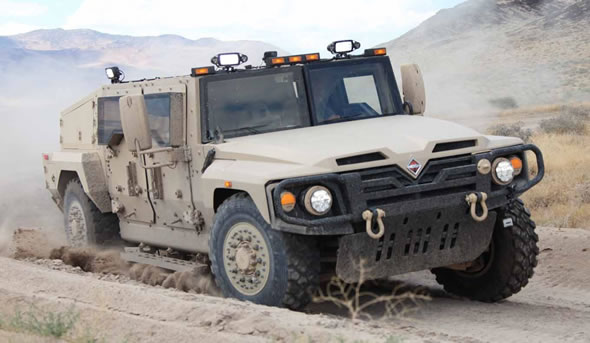
Navistar Introduces the Saratoga Light Tactical Vehicle

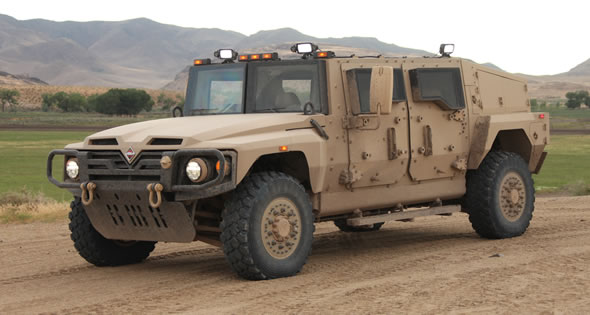
Navistar's new Saratoga, light tactical armored vehicle. Photo: Navistar Defense
Navistar Defense introduced today the Saratoga light tactical vehicle at the Association of the United States Army (AUSA) Annual Meeting and Symposium today. The vehicle is targeted to gap between the projected upgraded High Mobility Multi-purpose Wheeled Vehicle (HMMWV) Modernized Expanded Capacity Vehicle (MECV) and future Joint Light Tactical Vehicle (JLTV) programs. The 10 ton vehicle has a payload of 3.2 tons including the four-passengers, plus an optional gunner accommodated in the armor and blast protected cab.

Saratoga at a maximum combat weight of about 10 tons, Saratoga has the power and mobility for off-road operations. The open cargo compartment at the rear is visible in this photo. Photo: Navistar defense
The vehicle has been in development for over a year, and has already gone through extensive testing over more than 25,000 miles and is ready for production. A high degree of commonality with fielded vehicles that incorporate Navistar’s automotive systems. The new Saratoga uses the MaxxForce D6.0L V8 engine, automatic engaging limited slip differentials, Allison 2100 SP 6-SP Automatic Transmission and air independent suspension for added control.
Navistar has designed and tested its own proprietary geometry survivability solution for the vehicle. Navistar offers the vehicle with ballistic protection against small arms threat, mine and IEDs blasts, and other emerging threats. The armor suite employs metallic or ceramic armor with the protection suite designed to meet load limits without sacrificing maneuverability, horse power and torque, or payload capacity. Maintaining the floor height as high as possible was critical for effective blast protection. Therefore, the vehicle’s height was set at 83”. In order to meet the height requirement set by the Navy’s Marine prepositioned ships storage limit, the vehicle uses compressed suspension to ‘Kneel’ down, reducing seven inches to fit into the 76” height of the Navy transport ships. The gross vehicle weight is 9.979 ton (22,000 lbs), with a maximum payload of 3.265 tons (7,200 lbs.) Its length is 5.72 m’ (222”) with the wheel base making 4.01 m’ (158”).
Saratoga can 'kneel', reducing seven inches in height down to 76", to fit into Navy cargo vessels. Photo: Navistar Defense

The German Navy – The Way Forward?

RBS15 Mk3 is the main surface offensive weapon carried on the new K130 missile corvette.
One of the largest fleets in NATO, the German Navy appears to have escaped most of the recent cuts imposed by the government’s austerity plan, since construction of the new vessels and upgrades for existing platforms seems to continue. However, the planned reduction of 60 percent in its defense budget could have negative effect in the future, if the government decides to press on with the cuts. To continue operating under these restricted budgetary constraints the Navy may have to reduce its mission sets, whilst assuming a reduced ‘asymmetric’ role focused on counter-piracy, peacemaking and peacekeeping operations, rather than full scale, high intensity operations.
In addition to taking part in current NATO activities the German Navy deploys routinely at the Baltic Sea and is taking part in many international operations, including peacekeeping operations, security and counter piracy activities, as far as Africa and the Indian Ocean. In total, there are about 90 commissioned warships in the German Navy including 43 auxiliary ships; the total displacement of the navy is 220,000 tons. In addition to this, the German Navy and the Royal Danish Navy are in cooperation in the “Ark Project”. This agreement made the Ark Project responsible for the strategic sealift of German armed forces where the full-time charter of three roll-on-roll-off cargo and troop ships are ready for deployments. In addition, these ships are also kept available for the use of the other European NATO countries. The three vessels have a combined displacement of 60,000 tons. Including these ships, the total ships’ displacement available to the Deutsche Marine is 280,000 tons.

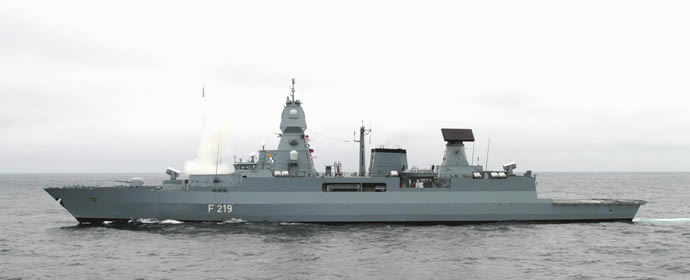
F219 Sachsen, the lead F124 class frigate german navy
F219 Sachsen, the lead F124 class frigate german navy fires an ESSM air defense missile.
The German Navy operates two flotillas, the surface fleet which includes 15 frigates of three types and Type 212 subs, with a squadron of ten fast missile boats operating in the Baltic sea. In recent years the German Navy went through major modernization, with the fielding of the F-124 class frigates, K130 corvettes and Type 212 submarines, all locally built by the Blohm & Voss, Lürssen, ThyssenKrupp Marine Systems (TKMS) and Howaldtswerke Deutschland Werct (HDW) shipyards.
The seeming stability does not reflect years of decline in new orders, which almost brought the HDW submarine builder to a standstill and drove TKMS to sell most of its naval and commercial surface shipbuilding assets to the UAE in 2009. The company agreed to establish a “close strategic partnership” and Memorandum of Understanding with the Abu Dhabi MAR (ADM) group in the United Arab Emirates. The proposed sale followed related purchases in Germany by Abu Dhabi MAR, and other recent shipyard sales by TKMS. The net effect was a restructuring of Germany’s naval shipbuilding industry.
The envisioned agreement involved a 50/50 joint venture to build naval surface ships, with TKMS retaining a lead role and know-how in all projects with the German Navy and NATO partners, while ADM was responsible for the Middle East and North Africa. At the same time, however, Abu Dhabi MAR would acquiring 80% of TKMS’ key surface ship firms: Blohm and Voss Shipyards, Blohm and Voss Repair, and Blohm and Voss Industries. That deal has largely fallen through in 2011, leaving TKMS naval assets “in play” again.
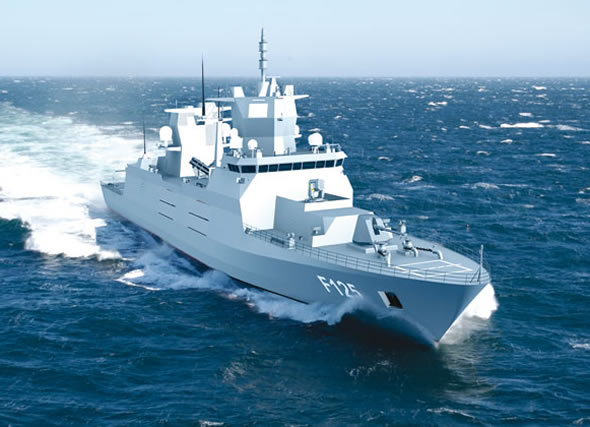
Today, the German Navy maintains two operates 15 frigates of three types – the Bremen (8), Brandenburg (4) and Sachsen class (3), which is also the newest (F124 class) air defense frigates. In November 2011 Germany laid the keel of the first of four F125 next generation frigates ‘stealth design’, likely to be one of the world’s largest class of frigates with a displacement in excess of 7,200 tonnes, expected to enter service in 2016 in time to replace the first Bremen class frigates. Although the crew is to be reduced to 120 sailors, instead of the planned 235 crew, the vessels will operate with the “two crew concept”, as the vessel is capable of long endurance at sea. Completion of the F125 fleet is anticipated by December 2018.
The German frigates carry MBDA MM-38 Exocet anti-ship missiles, Raytheon RIM-162 Evolved Sea-Sparrow Missiles developed under a multinational NATO cooperation and RIM-116 Rolling Airframe Missiles built under a German-U.S. cooperation also led by Raytheon with Diehl BGT Defence as its German partner. The vessels are also equipped with advanced radars, sophisticated combat information systems built by EADS and combined ESM/ECM supplied by the UK.
New Shipbuilding Programs
There are three ongoing naval construction programs: Type 212 submarines (two of a total six boats on order are yet to be delivered), four F125 frigates, the keel of the first one was laid this month, and three K130 corvettes yet to be delivered.
F125 class frigate for the german Navy
The first of four F125 class frigates is scheduled for delivery by 2016. Photo: TKMS
While all shipbuilding programs are exclusive to Germany, the weapon systems, parts of the radar and other electronics subsystems are being developed as part of international cooperations, to reduce development cost.
The F125 program will deliver four ships between 2014 and 2018. The program focuses on long endurance vessel optimized for asymmetric warfare and peacetime operation far from its home port. As such, the 5,500 ton vessel will have a crew of up to 120 personnel, about half of the crew that were required to operate previous generation frigates. The vessel will also be able to support special forces teams of 50 personnel.
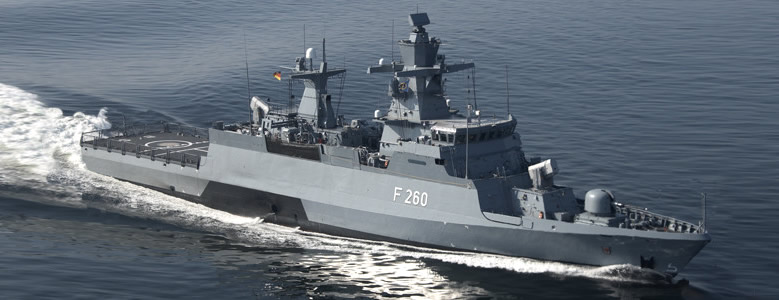
The navy is in the process of inducting the first two of five new Braunschweig Class K130 corvettes, based on the MEKO A design, with three more under construction. These corvettes are supplementing the squadron of fast missile boats and will better support typical operations assumed by the German Navy, including anti-piracy support. K130 is also designed for a lean crew, operated by a complement of 65. These corvettes represent a mix of systems and technologies from different European and Scandinavian makers – the radar is made by EADS in Germany, as well as the ESM and countermeasure systems. The command, control, communications and optronic fire control systems comes from Thales Netherlands; the 76/62mm gun is an Italian system from Oto-Melara while the main weapon system is the Swedish RBS15 Mk3. The later is a surface launched fire-and-forget long range anti-ship and land attack missile, developed by the Saab Group. To gain economy of scale and share the program’s life cycle cost, Germany, Poland and Sweden have decided to collaborate and equip their new vessels with the new missile. Marketed jointly by Diehl and Saab, RBS-15 Mk3 is being offered as a future armament of its frigates and potential replacement of earlier Exocet and Harpoon missiles.
German Navy K130 Braunschweig class corvette F263 Oldenburg
The german Navy will operate five K130 Braunschweig class corvettes. The vessel in the photo is the fourth ship, F263 Oldenburg. Photo: TKMS.
A squadron of ten Gepard class Fast Missile Boats, equipped with MM38 Exocet anti-ship missiles is also operational, but the number of boats has being reduced gradually. Under the 2010 announced budget cuts, the Navy will retire its Gepard class fast missile boats. The first vessels, Nerz and Dachs will be retired by March 2012. Other Type 143A boats retained as operational performed training in the Baltic Sea in November 2011.
Modernizing the Submarine Force
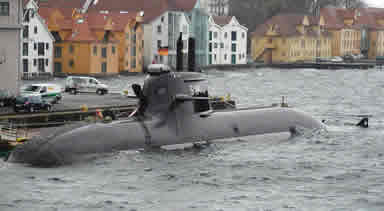
U-212 class submarine at Bremen, 2007
U-212 class submarine U-34 (S-184) at Bremen, 2007
Until recently the German Navy operated a flotilla of ten submarines, based at Eckernförde. Up to 2010 the German submarine fleet consisted of modernized Type 206A diesel-electric submarines, which were originally commissioned between 1973 and 1975, and upgraded since 1992, and four new hybrid diesel-electric/fuel cell air independent propulsion (AIP) Type 212A submarines, which were commissioned between 2004 and 2006. In 2010 the remaining Type 206A subs were retired from active service as part of the Bundeswehr budget cuts. Current plans foresee a total of six Type 212A boats, with the final two vessels projected to become operational by 2012 and 2013 respectively. The original plan was to construct a total of eight Type 212 vessels, but in January 2004 the German Defense Ministry announced that no more submarines would be ordered until 2016.
Germany possesses a manufacturing capability at HDW for a diesel-electric special export-only submarine, the type 800 Dolphin class and has exported numerous variants of these, Turkey and Israel being amongst its customers. This is perceived as a very capable conventional submarine, with various shipyards offering upgrades.
The German Navy’s main roles, in conjunction with other NATO navies or as part of a UN force, are conflict prevention, crisis management, peacekeeping and counter-terrorism operations. As a result of the 212A submarine’s stealth capabilities, it is also able to carry out effective covert intelligence and reconnaissance missions. German submarines were deployed as part of peacekeeping operations in the Adriatic Sea during the mid-1990s, and as part of NATO operation “Active Endeavour” and support to the US-led conflict in Afghanistan “Enduring Freedom”.
In support of new operational priorities, there are future plans to equip the 212A with a land-attack capability. The Interactive Defense and Attack System for Submarines (IDAS), currently under development by Diehl BGT Defence, HDW and Kongsberg of Norway, uses a wire-guided missile to engage helicopters and mobile targets on shore. The third Type 212 submarine, U33 was selected as the platform for testing the new weapon. The missile made the first flight in June 2008, successfully launched from the torpedo tubes of the submerged submarine.
Mine Countermeasures Fleet
The German Navy operates five Type 352 minesweepers equipped with hull mounted DSQS-11 mine detection sonar and the ‘Troika Plus’ system, comprising a manned mothership and unmanned Seahound (seal) vessels being the lead element. Some of the older Type 333 (converted fast gun boats) are currently being retired.

About the author: Peter L. Hartley, MSc, CAET, MInstP, MIET
With 41+ years experience in defense electronics (radar, electronic warfare, C3I and CIS and mission systems) and associated activities, Peter Hartley offers a wide range of skills and capabilities in the field of Systems including System Architecture, Bid Management, Bid Reviews at national/international levels, Business Development (and Business Creation), Customer Liaison, Contract Negotiation, Marketing Support, Engineering Management, Design Authority, Team Building, and Research.

Mica VL Naval Air Defense Systems Delivered, Land Variant to Follow Soon

MBDA has delivered the first VL MICA naval surface-to-air defense systems to the first export customer and is moving the land-based VL MICA land system into production, anticipating first export deliveries starting in 2012. The launch customer for both systems is believed to be Oman.
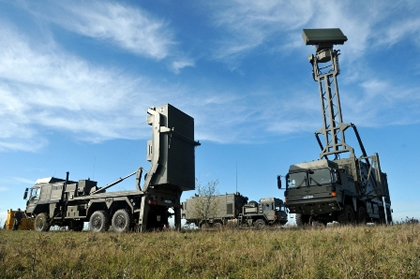
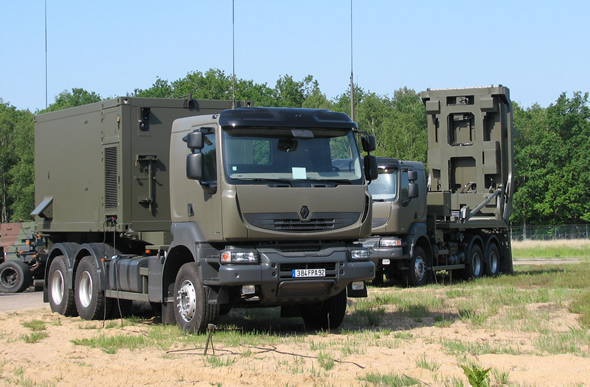
system’s elements will be networked to validate a standard operational configuration. The French Air Force has taken part in the VL MICA land program since 2009, as part of the technical and operational assessment of the VL MICA demonstrator. Photo: MBDA
The naval-based Mica-VL will be deployed on three Omani Navy Khareef corvettes scheduled for delivery starting in 2012. The land-based version is expected to replace the obsolete Rapier currently in service with the Omani land forces. The Moroccan Navy is also believed to be a customer for the Naval Mica VL , to equip its Dutch built Sigma class corvettes built in the Netherlands.
MBDA is moving the land-based VL MICA land system into production, anticipating first export deliveries starting in 2012. Photo: MBDA
Mica VL (Land) has been ordered by the French Air Force and part of the system’s equipment has already been delivered to the French airbase, where the system’s elements will be networked to validate a standard operational configuration. The French Air Force has taken part in the VL MICA land program since 2009, as part of the technical and operational assessment of the VL MICA demonstrator.

Successful Test of the U.S. Army Hypersonic Weapon Concept

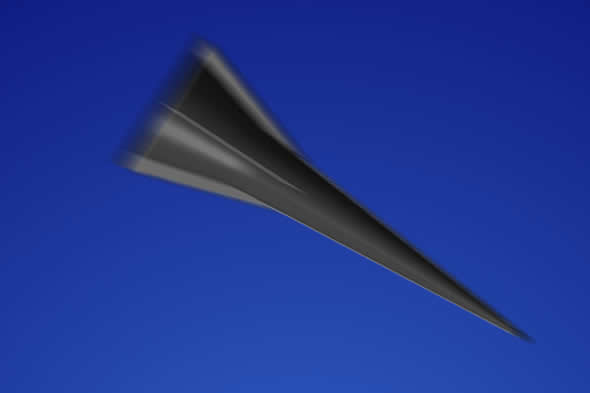
Advanced Hypersonic Weapon
Today the U.S. Army Space and Missile Defense Command/Army Forces Strategic Command conducted the first test flight of the Advanced Hypersonic Weapon (AHW) concept. Riding on a three-stage Strategic Targets System (STARS) booster stack, the Hypersonic Glide Body (HGB) was accelerated to hypersonic speed of mach 5 (3,728 mp/h), flying a glide trajectory to impact on the Reagan Test Site at Kwajalein Atoll.
Through the mission the AHW provided telemetry data about flight systems behavior, thermal loads, and other system performance data to verify analytical models, and demonstrating advanced aerodynamic control maturity. The glide vehicle was launched after midnight today, on 1:30 a.m. Hawaii-Aleutian Time (6:30 a.m. EST), from the Pacific Missile Range Facility, Kauai, Hawaii to the Reagan Test Site, U.S. Army Kwajalein Atoll. Shaped as a glide vehicle, the weapon is designed to fly within the earth’s atmosphere at hypersonic speed and long range. This single flight demonstration emphasized aerodynamics; navigation, guidance, and control; and thermal protection technologies.
The data collected will be used by other DOD programs, to model and develop future hypersonic boost-glide capabilities. The AHW is part of the Pentagon’s US$600 million Conventional Prompt Global Strike (CPGS) program, aimed at providing U.S. military services with conventional attack weapons capable of striking anywhere on earth within less than 60 minutes. As part of the CPGS effort, the Defense Advanced Research Projects Agency conducted two tests of boost-glide flight tests of the Hypersonic Technology Vehicle (HTV-2) in April 2010 and August 2011, results from which were used in planning the AHW flight test. DARPA and the Air Force Space and Missile Systems Center are also developing a parallel hypersonic glide weapon known as the Conventional Strike Missile (CSM), expected to deliver a weaponized demonstration flight in the second quarter of 2012. If proven feasible, CSM could become operational as a land-based missile by 2017. The objective of such an Advanced Hypersonic Weapon is to provide a transformational capability on the order of 6,000-kilometer range with 35 minutes time-of-flight and ten-meter accuracy or better.
The AHW program is managed and executed by the U.S. Army Space and Missile Defense Command/Army Forces Strategic Command program office in Huntsville, Ala.  The booster system and glide vehicle were developed by Sandia National Laboratories, Albuquerque, N.M. and the thermal protection system by the U.S. Army Aviation and Missile Research Development and Engineering Center, Huntsville, Ala.

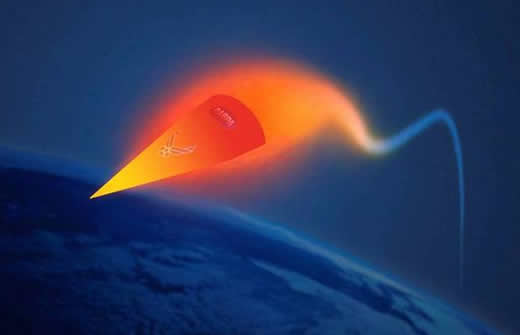
While the smaller AHW is designed to fly at five times the speed of sound (Mach 5), The Falcon HTV-2 hypervelocity vehicle aimed at four times that speed (Mach 20), thus reaching targets 4,000 nautical miles away in 30 minutes. Image: DARPA

Unmanned Systems Unveils the Orca Tip-jet UAV at Dubai 2012

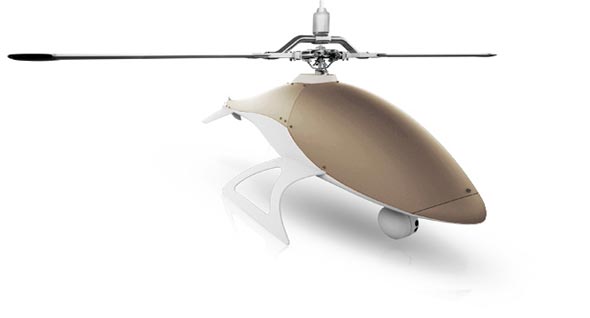
The Swiss company Unmanned Systems is showing a model of its Orca rotary-wing unmanned air vehicle at the Dubai 2011 Airshow. The Orca employs a revolutionary tip-jet propulsion method that not only improves performance in many key areas, but also overcomes many of the operational problems encountered with conventional propulsion methods AIN reports.
ORCA-I (ISTAR) Image: Unmanned Systems
Orca’s system employs a turbine engine rated at 215 hp that rotates with the rotor blade. The jet blows air at 700-degrees (C) through flexible ducts to the hollow rotor blades, then blowing through angled tip nozzles to provide thrust. Reactive movement is eliminated so there is no requirement for a tail rotor, and there is no need for clutch, gearbox or transmission, significantly reducing weight.
According to the Swiss company, this propulsion systems has numerous benefits, not least of which are low running costs and high availability. At  a 772-pound maximum take off weight, the Orca is designed to lift up to 265-pound payload, flying at an altitude of up to an 1,500-foot ceiling. Typical endurance on 33 gallons of fuel is 2.5 hours.
The company is currently testing the propulsion system on a tower, and expects to conduct the first flight of the Ocra in April next year. Initially the Orca is being developed as an ISR platform, carrying a FLIR Ultra Force 350 EO/IR payload as standard. In Dubai the company highlights the ability of the UAV to operate with great reliability in desert conditions, as its enclosed propulsion system is impervious to dust and sand. Nevertheless, when cold weather operations are concerned, the blowing of hot air through the hollow blades eliminates any icing issues.
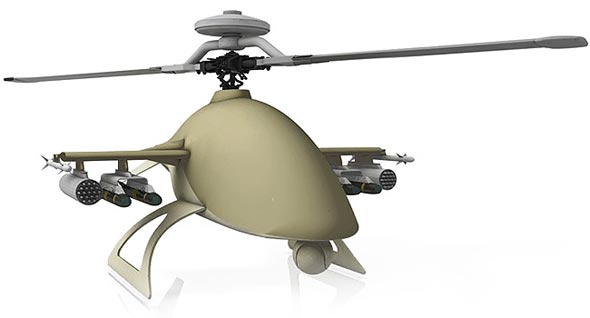
ORCA-S (STRIKE). Image: Unmanned Systems
Following close behind the ISR version will be a maritime surveillance model. A weaponized version is also being planned, to be ready in 2013. This would be a larger air vehicle with a 2,095- to 2,205-pound mtow, of which about half would be payload. (AIN Online)