A Taiwan
aviation museum is sending an American aviation museum two demilitarized
F-5 jets in return for a World War II era B-26. The Taiwanese want a
B-26 to put on display because the Taiwanese Air Force operated B-26s
from 1958-74 to collect electronic intelligence (transmissions of radars
and other electronics) off the Chinese coast. Fifteen of the Taiwanese
B-26s were lost to accidents or Chinese gunfire. After the 35th "Black Cat" squadron was disbanded, all the remaining B-26s were scrapped before a museum could grab any.
Some 5,200 of these twin-engine, 17 ton bombers were built
during World War II. Most were scrapped by the late 1940s. But hundreds
remained in use for another decade or more.
The Black Cat squadron also operated 19 U-2 reconnaissance
aircraft from 1959-74, and one of these aircraft is on display in
Taiwan. Taiwanese U-2s flew 102 missions over China, North Korea and
North Vietnam. Five Taiwanese U-2s were shot down, three pilots were
killed and two captured.
pondělí 2. ledna 2012

The Unstoppable Carl Gustav
January 1,
2012: After two decades of resisting calls from the troops for the
Swedish 84mm Carl Gustav portable recoilless rifle, the U.S. Army has
relented and ordered about a hundred Carl Gustav launchers. After
watching U.S. Army Special Forces use this weapon in Afghanistan and
Iraq for the last decade, the army brass reconsidered. This weapon has
been around for over 60 years and is used by several dozen countries. It
is simple, but very effective.
The Carl Gustav was adopted by SOCOM (first for the Ranger
Regiment) in 1990. The Carl Gustav is basically a lightweight 8.5 kg (19
pound) recoilless rifle. It is 1.1 meters (3.6 feet) long. The barrel
is rifled and good for about a hundred rounds. Range is 500-700 meters
(depending on type of round fired.) The 84mm projectiles weigh about 2
kg (4.4 pounds) each and come in several different types (anti-armor,
combined anti-armor/high explosive, illumination and smoke.) The
anti-armor round is very useful in urban areas and against bunkers.
The army had earlier adopted the single shot version of the
Carl Gustav (as the AT4), but the Special Forces showed that the Carl
Gustav is better because you get more shots for less weight (the AT4
weighs about 6.8 kg each). It's easier to carry one Carl Gustav, at 8.5
kg, and a bunch of rocket propelled shells at about 2.2 kg (5 pounds
(with packaging) each.
Foreign troops fighting in Afghanistan continue to pay a high toll, with more than 560 killed in 2011, the second highest number in the 10-year war against the Taliban-led insurgency. Commanders from the NATO-led International Security Assistance Force (ISAF) say violence is declining following the US military surge which saw an extra 33,000 troops on the ground. But the UN says violence is up, while recent mass casualty strikes by the Taliban on civilians and coalition troops have fuelled analyst predictions that more bloodshed is likely as NATO hands control for security to Afghan forces. The death toll of coalition service personnel in 2011 was 566 and includes at least 417 from the US and 45 from Britain, according to an AFP tally based on figures from independent website icasualties.org. The number is down from a wartime high of 711 in 2010 after the start of the surge but up from 521 in 2009. The toll in 2011 was added to on the final day of the year when ISAF announced a service member had died after a non-battle related incident in the south. The fatality count has been worsened by several devastating attacks, including the car bombing of an ISAF convoy in Kabul in October which killed 17, and the shooting down of a helicopter in Wardak, south of the capital, in August in which 30 US troops perished. But it is Afghan civilians who have paid the highest price. The deadliest attack saw at least 80 people killed in a shrine bombing in Kabul on the Shiite holy day of Ashura in early December. The surge troops -- ordered in by US President Barack Obama two years ago to turn the tide in the war -- have now begun to pull out, with 10,000 already gone and the rest leaving by next autumn. Other foreign forces are also scaling down their missions ahead of a 2014 deadline for the withdrawal of all NATO combat forces. And one Western military official said some units have already been told not to carry out offensive operations. Since the US-led invasion toppled the Taliban from power in 2001, a total of 2,847 foreign troops have died in the conflict. "We've seen a considerable reduction in enemy attacks (this year). That's a result of successes on the battle field and a reduction of their capability to attack us," said ISAF spokesman Brigadier General Carsten Jacobson. While fewer ISAF troops on the ground in the coming years may mean fewer coalition deaths, the civilian toll will not necessarily fall. The UN said the number of civilians killed in violence in Afghanistan rose by 15 percent in the first six months of this year to 1,462. A full-year report is due out in mid-January. Insurgents are blamed for 80 percent of the deaths, which are mostly caused by homemade bombs or IEDs. NATO, which says enemy attacks are down eight percent, only includes "executed attacks" and not IED finds or instances where the Taliban intimidate local people. Haroun Mir, an analyst at Afghanistan's Centre for Research and Policy Studies, said that while the Taliban were no longer engaging ISAF troops head-on, factions within the insurgency were intent on targeting civilians. "The Taliban are deliberately targeting civilians to spread fear among the people. They want to show that despite the surge they are still active, that they have the capacity to disrupt life, especially in the cities," he said. The international community is looking for a political solution to the war and moves have been made to establish a Taliban office, possibly in Qatar, to enable peace talks. But Mir said although some members of the Taliban would be willing to negotiate, others, such as those based over the border in Pakistan, are likely to become increasingly isolated and unleash more violence. "We expect more terrorist attacks and more political assassinations during the phase of transition. These radical groups will do everything possible, especially after 2014, to weaken the government," he said. As security is handed over the Afghan National Security Forces (ANSF), which now number more than 300,000, can also expect to take on more casualties. Since March 21, the beginning of the Afghan year, 1,400 police, 520 soldiers and 4,275 insurgents have been killed in the conflict, according to Afghan government figures. However, there is some optimism that the reduction in the foreign presence may in itself lead to a fall in violence. "The hope is that as foreign troops hand security to Afghan forces fewer local people will become radicalised," said Fabrizio Foschini of the Afghanistan Analysts Network. "And the insurgents won't kill as many civilians collaterally by using highly destructive tactics to target foreigners," he said.
Boeing won a $3.48 billion contract Friday to retain its leading role in building a US shield against long-range ballistic missiles, defeating rival Lockheed Martin Corp., officials said Friday.
The US Missile Defense Agency announced the decision for the seven-year contract in which Boeing will test, engineer and manufacture the system designed to thwart potential attacks from intercontinental ballistic missiles.
Chicago-based Boeing was joined by partner Northrop Grumman, which will oversee the ground system and other aspects of the project, Boeing said in a statement.
Boeing offered "innovative solutions and a cost-effective approach to program management and execution," said Dennis Muilenburg, president and CEO of Boeing Defense, Space and Security.
Lockheed, based in Bethesda, Maryland, had hoped to edge out Boeing, which has been the prime contractor for the anti-missile program since 2001.
The ground-based mid-course missile defense system has had a mixed record on missile tests, with two failures in 2010. The program has also faced cost overruns due to faulty parts, and the Pentagon is now requiring contractors to absorb the cost of defects in the future.
566 coalition troops die in Afghan war in 2011
Foreign troops fighting in Afghanistan continue to pay a high toll, with more than 560 killed in 2011, the second highest number in the 10-year war against the Taliban-led insurgency.
Commanders from the NATO-led International Security Assistance Force (ISAF) say violence is declining following the US military surge which saw an extra 33,000 troops on the ground.
But the UN says violence is up, while recent mass casualty strikes by the Taliban on civilians and coalition troops have fuelled analyst predictions that more bloodshed is likely as NATO hands control for security to Afghan forces.
The death toll of coalition service personnel in 2011 was 566 and includes at least 417 from the US and 45 from Britain, according to an AFP tally based on figures from independent website icasualties.org.
The number is down from a wartime high of 711 in 2010 after the start of the surge but up from 521 in 2009.
The toll in 2011 was added to on the final day of the year when ISAF announced a service member had died after a non-battle related incident in the south.
The fatality count has been worsened by several devastating attacks, including the car bombing of an ISAF convoy in Kabul in October which killed 17, and the shooting down of a helicopter in Wardak, south of the capital, in August in which 30 US troops perished.
But it is Afghan civilians who have paid the highest price.
The deadliest attack saw at least 80 people killed in a shrine bombing in Kabul on the Shiite holy day of Ashura in early December.
The surge troops -- ordered in by US President Barack Obama two years ago to turn the tide in the war -- have now begun to pull out, with 10,000 already gone and the rest leaving by next autumn.
Other foreign forces are also scaling down their missions ahead of a 2014 deadline for the withdrawal of all NATO combat forces. And one Western military official said some units have already been told not to carry out offensive operations.
Since the US-led invasion toppled the Taliban from power in 2001, a total of 2,847 foreign troops have died in the conflict.
"We've seen a considerable reduction in enemy attacks (this year). That's a result of successes on the battle field and a reduction of their capability to attack us," said ISAF spokesman Brigadier General Carsten Jacobson.
While fewer ISAF troops on the ground in the coming years may mean fewer coalition deaths, the civilian toll will not necessarily fall.
The UN said the number of civilians killed in violence in Afghanistan rose by 15 percent in the first six months of this year to 1,462. A full-year report is due out in mid-January.
Insurgents are blamed for 80 percent of the deaths, which are mostly caused by homemade bombs or IEDs.
NATO, which says enemy attacks are down eight percent, only includes "executed attacks" and not IED finds or instances where the Taliban intimidate local people.
Haroun Mir, an analyst at Afghanistan's Centre for Research and Policy Studies, said that while the Taliban were no longer engaging ISAF troops head-on, factions within the insurgency were intent on targeting civilians.
"The Taliban are deliberately targeting civilians to spread fear among the people. They want to show that despite the surge they are still active, that they have the capacity to disrupt life, especially in the cities," he said.
The international community is looking for a political solution to the war and moves have been made to establish a Taliban office, possibly in Qatar, to enable peace talks.
But Mir said although some members of the Taliban would be willing to negotiate, others, such as those based over the border in Pakistan, are likely to become increasingly isolated and unleash more violence.
"We expect more terrorist attacks and more political assassinations during the phase of transition. These radical groups will do everything possible, especially after 2014, to weaken the government," he said.
As security is handed over the Afghan National Security Forces (ANSF), which now number more than 300,000, can also expect to take on more casualties.
Since March 21, the beginning of the Afghan year, 1,400 police, 520 soldiers and 4,275 insurgents have been killed in the conflict, according to Afghan government figures.
However, there is some optimism that the reduction in the foreign presence may in itself lead to a fall in violence.
"The hope is that as foreign troops hand security to Afghan forces fewer local people will become radicalised," said Fabrizio Foschini of the Afghanistan Analysts Network.
"And the insurgents won't kill as many civilians collaterally by using highly destructive tactics to target foreigners," he said.
Japan developing cyber weapon: report
Japan has been developing a virus that could track down the source of a cyber attack and neutralise its programme, the daily Yomiuri Shimbun reported Sunday.
The weapon is the culmination of a 179 million yen ($2.3 million) three-year project entrusted by the government to technology maker Fujitsu Ltd to develop a virus and equipment to monitor and analyse attacks, the daily said.
The United States and China are reported to have put so-called cyber weapons into practical use, Yomiuri said.
Japan will have to make legal amendments to use a cyber weapon as it could violate the country's law against the manufacture of a computer virus, the daily said.
In November a computer system run by about 200 Japanese local governments was struck.
In October, Japan's parliament came under cyber attack, apparently from the same emails linked to a China-based server that have already hit several lawmakers' computers.
It was also reported that Japanese computers at embassies and consulates in nine countries were infected with viruses in the summer.
Currently, the virus is being tested in a "closed environment" to examine its applicable patterns.
Pakistan, India swap lists of nuclear sites
Pakistan and India on Sunday exchanged lists of their nuclear sites under an accord which prohibits both sides from attacking these locations, the foreign ministry in Islamabad said.
Under the 1988 agreement, the nuclear-armed neighbours are required to submit the lists of all their respective nuclear installations and facilities -- civilian and military -- on January 1 every year.
"In accordance with the aforesaid agreement, a list of requisite facilities in Pakistan was given to the Indian high commission official at the foreign office today," a statement from Pakistan's foreign ministry said.
The Indian side also handed over its list to the Pakistan high commission official at the ministry of external affairs in New Delhi, it added.
Relations between India and Pakistan, which have fought three wars since the subcontinent was partitioned in 1947, have been plagued by border and resource disputes, and accusations of Pakistani militant activity against India.
Two of the three wars were over Kashmir, which both countries claim in full. The neighbours and rivals were on the brink of nuclear conflict in 2002 over the Kashmir tensions.
A slow-moving peace process resumed in March 2010, after 166 people were killed in the 2008 Mumbai attacks blamed on Pakistani extremists.
As part of the resumed dialogue process, experts from the two countries recently held peace talks in Islamabad on nuclear confidence-building measures.
úterý 27. prosince 2011
Asia Pacific Defense UAsia Pacific Defense Updatepdate
Indian MOD: Both MMRCA Bids are Significantly Higher than Goal
According to the Indian MOD’s ‘Year-end Review’, the final decision on the winning bid for the Medium Multi-Role Combat Aircraft (MMRCA) is expected within two weeks. Following the announcement MOD will negotiate the final price. MoD sources indicate that the prices quoted by both Eurofighter and Dassault are significantly higher than the US$8 billion (42,000 crore) the Indian Cabinet cleared for the program. It is estimated that both bids are in the $100 million per aircraft range. The Gripen, MiG-35 and F-16 are believed to have met the Indian threshold. Defense Update has learned the F-16 was offered at a $70 million and the Super Hornet was offered ‘below $100 million per aircraft’; however, all lost to the two European proposals which were the highest bids. The US has recently offered the F-35 to Japan and Israel at around $120 million a piece.Japan Japan Formally Announces F-35 Selection
F-35J for Japan
Indian Air Force Opts for More Su-30MKI, Despite Problems

IAF Su-30 MKI
Cheongung – a New MR-SAM for the South Korean Multi-Tier Defense System

Cheongung (MR-SAM) anti-aircraft missile from South Korea
Stealth Infiltration Boats for South Korea
December 17, 2011: As part of its new proactive defense strategy Seoul is pursuing new military capabilities that will enable its forces to preempt or retaliate on any provocation from the North. Among those means are special operations capabilities to be acquired by the Navy. Seoul is allocating 900 billion ($700 million) to develop special boats capability, enabling Navy Special Forces carrying the attack to the enemy area. The navy will oversee the development of two types of special stealth fast boats – one fir personnel infiltration and one carrying logistical supplies in support of such forces.Australia opts for the Spartan

Alenia/L3 C-27J Spartan
Australia Revamps Reserve Brigades under Plan BeerSheba
December 16, 2011: Plan BeerSheba announced by the Australian Defence on December 12, 2011 aims to ensure that the country continues to contribute forces to operations including Afghanistan and successfully transition to a force that is able to respond effectively to future challenges, including humanitarian assistance and disaster relief and other operations. The restructuring of the ground forces designed to achieve a greater integration of the Regular Army and reserve component, introduce amphibious operational capabilities of the Australian land forces. (Defense-Update)Russia to Deliver Leased Nuclear Submarine, Offers Conventional subs to India

Nerpa - to be renamed Chakra
Navantia to Build 12 landing crafts for Australia

LCM-1E landing craft
Australia Selects Hawkei for its Future Protected, Light Tactical Vehicle

Australia is set to buy 1,300 Hawkei vehicles for A$1.5 billion
Australia Beefs up Route Clearing Pathfinders
December 12, 2011: The Australian Defence department is sending four new route clearing Bushmaster vehicles fitted with counter-IED mine rollers, ground penetrating radar, robotic extension arms and armored excavators to equip the Australian troops in Afghanistan better preparing them to counter the IED threat and repair road damaged by such attacks. The Australians have also beefed up the armor protection of existing Bushmaster. In May 2011 an order for additional 101 Bushmasters was awarded to Thales, which has also included the possible protection enhancement. Following successful test conducted with the Bushmasters a protection upgrade kit was developed, which includes changes to the seats, and stronger welding for the hull, protecting against blast effect. The enhancement is performed on the new production batch as well as theose vehicles currently in operation in Afghanistan.Thailand Minehunters to get the SeaFox

SeaFox - C photo: Atlas Elektronik
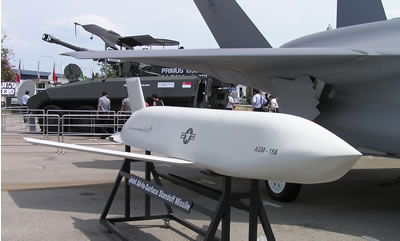
South Korea Favors JASSM for its U.S. made Fighters
AGM 158 JASSM
Embraer Flies Indian Bound ERJ-145 AEW Aircraft
December 7, 2011: Brazilian aerospace company Embraer has flown the aircraft designed and built for the Indian Compact Airborne Early Warning Aircraft developed by the Defense Research and development organization (DRDO) Centre for Airborne Systems (CABS). The delivery of the first of three aircraft is scheduled for the first half of 2012. The aircraft is based on the proven ERJ-145 regional jet, modified with in-flight refueling probe, satellite communications terminal, expanded power supply and cooling resources.Brunei Orders 12 S-80i Black Hawk Helicopters
December 7, 2011: The ministry of Defense of Brunei has signed with helicopter manufacturer Sikorsky an order for 12 S-70i Black hawk helicopters, to be delivered starting in 2013. The contract contains options for orders of 10 additional helicopters. As part of the program Sikorsky will provide simulator training for Burnei helicopter pilots, familiarizing them with the new systems. The U-70i is the latest international version of the Black hawk.Indonesia to Expand Su-27/30 Fleet to a full Squadron
December 7, 2011: Indonesia plans to increase its Su-27/30 fleet to a full squadron, flying 16 Su-27SK/SKM and Su-30MK/MK2 aircraft. The country is negotiating with Russia the delivery of six Su-30MK2 fighters to be configured into naval strike fighters. In addition, the Indonesia is tightening its relations with the U.S., in anticipation to receive two squadron of modernized F-16s by 2014. The aircraft are to be provided from U.S. Air Force surplus as a grant by the a U.S. government, with Indonesia paying for their restoration into flying status, system modernization, upgrades and weapons, expected to cost about US$670 million.First NH90 Delivered to New-Zealand
December 6, 2011: After two years delay, New Zealand received the first two of eight NH90 helicopters ordered in 2006 were delivered by the manufacturer NHI. The delivery of the helicopters was originally scheduled for 2009 but was delayed due to the software integration and certification issues. In fact, the helicopters are not flightworthy yet, as some of their software and mission computers are yet to be delivered. The NH90 will complement the five AgustaWestland AW-109 helicopters that also arrived in 2011.India Plans Doubling its Maritime Reconnaissance Fleet with 12 Additional P-8Is

P-8I made its first flight on September 26, 2011. Photo: Boeing
Underwater Surveillance Vehicle for japan’s Coast Guard

the Canadian Explorer AUV from ISE
Defending The Homeland – The Future Of Japan’s And Taiwan’s Air Defense
The unsettling appearance of a Chinese aircraft carrier has created
quite a stir in the Pacific among those nations that rely heavily on the
United States for warfighting protection and military hardware. With
the Chinese carrier now underway on its second round of sea trials, the
Pacific community is looking with increased urgency to improve air
defenses. Taiwan and Japan in particular are in critical need of an
upgrade to their existing air-superiority fighter forces.
Earlier this year, President Obama rejected Taiwan’s request to purchase as many as 66 new F-16 C/D aircraft to replace its aging fleet of F-16 A/B and F-5 fighters. The Obama administration has instead offered a deal to upgrade Taiwan’s existing fleet of the A/B versions of the F-16. This $5.85 billion upgrade will give the older F-16s most of the advanced capabilities of the C/D versions. With the upgrade, the older F-16s would receive enhanced radar, avionics, and weaponry. Taiwan was quick to publicly welcome the offer of the upgrade.
Unfortunately, the planned upgrade will do little to alleviate
the problem of keeping the Taiwanese F-16 fleet in the air for any
length of time. The F-16s and F-5s now in operation in Taiwan are tired
aircraft that have already been in service far longer than their
designed lifespan. The F-16s date back as far as 1992 and the F-5s are
Vietnam-era aircraft that are of little use except as trainers. Taiwan
has been plagued by a series of aircraft crashes and safety stand downs
that are usually indicative of aging airframes that require continuous
maintenance and can, over time, render the aircraft unsafe for normal
operation.
Taiwan’s efforts to manufacture an air-superiority fighter of its own making yielded 130 aircraft that proved to be less capable than desired. With the assistance of American defense contractors, the initial concept was an idea that held a reasonable promise of delivering a homegrown fighter capable of meeting Taiwan’s air defense needs. Unfortunately, the project hit a snag when Taiwan was forced to exclude the high-thrust engines needed to make the aircraft a real warfighting threat. Enhanced models of the fighter are just now becoming a reality and may yet provide Taiwan with a viable homegrown air-superiority fighter.
Taiwan has also expressed a sincere interest in acquiring the new F-35 multirole fighter. There is very little likelihood that the F-35 will become part of the Taiwanese air fleet any time soon.
With the acquisition of new F-16s not likely in the short term and procurement of the F-35 little more than a dream, Taiwan’s ability to defend its air space against a determined Chinese aerial onslaught is critically limited, but the Taiwanese might have the capacity to give the Chinese a nasty reception in the event of open hostilities.
While Taiwan is forced to take whatever it can get to enhance its air defense capabilities, Japan remains undecided about the aircraft it wants as a replacement for its well-worn force of F-4EJ, F-2, and F-15J fighters. Recent accidents and groundings have exposed the Japanese air fleet’s maintenance nightmare of keeping its fighter aircraft aloft. Unlike Taiwan, Japan as a sovereign nation is not hogtied by the same political restrictions and second guessing facing Taiwan and is free to contract for the aircraft best suited to meet its air defense needs. That is, except for Lockheed Martin’s F-22 Raptor, an aircraft the United States is not yet willing to share.
Japan’s F-4EJ Kai Phantoms have been in service since the early 1970s and have certainly outlived their operational usefulness. The F-15Js have been operational since the early 1980s and are definitely showing their age. Production of the F-2 came to an end when the last aircraft was delivered on September 27 of this year. The air fleet is worn, outdated, and outclassed.
In 2010 both China and Russia intensified their testing of Japanese air defenses with hundreds of intrusions into Japanese air space – the largest number of unauthorized flights since 1991. The Japanese Air Self Defense Force (JASDF) was pushed to the limit in its efforts to meet this challenge in 2010 and the results were not cause for celebration. The intensity of the JASDF air operations further aggravated the problem of keeping aging aircraft operational.
With China recently unveiling its J-20 multipurpose fighter, reported to possess stealth technology and capability, and Russia announcing a joint project with India to develop its fifth-generation Sukhoi T-50 fighter, Japan is distressed to learn just how far behind potential adversaries its existing fighter defense force really is. The carrier sea trials being conducted by China have heightened the Japanese sense of being vulnerable to a host of very capable and very dangerous enemies.
 Unlike
Taiwan, Japan is in the enviable position of being free to choose a
replacement fighter that can stand up to the Chinese challenge. Japan
has narrowed the candidates she considers best able to defend her air
space to three aircraft, the Boeing F/A-18E/F Super Hornet, Lockheed
Martin’s F-35 Joint Strike Fighter (JSF), and BAE System’s Eurofighter
Typhoon.
One key criterion the Japanese government is using to determine the replacement to be chosen is the degree of manufacture/assembly the parent company will allow to be performed in Japan. All three manufacturers have indicated a willingness to offer Japan a licensing agreement giving Japan a specified level of manufacturing/assembly authority, but each is offering a slightly different level of authority.
The Japanese government has not made any announcement designating the aircraft to be purchased, but an announcement is expected late this month or early next month.
Most observers believe that the F-35 Lightning II is the replacement most likely to be selected as it is the most technologically advanced of the three and the most capable. Japan has historically opted for the most sophisticated weaponry available. However, the F-35 has experienced numerous production and testing delays and it carries a very hefty price tag. The F/A-18E/F Super Hornet is a very capable aircraft with an exceptional performance record and a much more palatable price tag. The Eurofighter Typhoon is also capable, but Japan has never bought a European warplane before and the United States must certainly be pressuring Japan to stay with an American aircraft. Some observers have also raised doubts about the Typhoons ability to be fully integrated into a largely American-equipped force. They are concerned that the Typhoon would unnecessarily complicate a maintenance and supply chain that is, by its very nature, already complicated enough.
While the F-35 appears to be the best fighter for the job, cost is a major consideration as well. Japan is burdened with debt that exceeds 200 percent of GDP and is continuing to increase. Japan’s leaders will have to decide between getting the best at great cost or getting a solid performer for a much lower cost. Which is now more important for Japan, the very best fighter available or a good first-class fighter that won’t break the piggybank?
About the author: Richard D. Dudley
U.S. Marine Corps Maj. (Ret) Richard D. Dudley has been serving with the Marine Corps in active duty for 26 years, rising from Private (E1) to retire as a Major (O4) with experience in numerous shipboard and shore-based deployments. During his service Maj. Dudley has specialized in logistics and support. For the past 15 years he is living in Japan serving as an independent sales consultant/local area manager with the Marine Corps Air Station in Japan.
Earlier this year, President Obama rejected Taiwan’s request to purchase as many as 66 new F-16 C/D aircraft to replace its aging fleet of F-16 A/B and F-5 fighters. The Obama administration has instead offered a deal to upgrade Taiwan’s existing fleet of the A/B versions of the F-16. This $5.85 billion upgrade will give the older F-16s most of the advanced capabilities of the C/D versions. With the upgrade, the older F-16s would receive enhanced radar, avionics, and weaponry. Taiwan was quick to publicly welcome the offer of the upgrade.
Taiwan’s efforts to manufacture an air-superiority fighter of its own making yielded 130 aircraft that proved to be less capable than desired. With the assistance of American defense contractors, the initial concept was an idea that held a reasonable promise of delivering a homegrown fighter capable of meeting Taiwan’s air defense needs. Unfortunately, the project hit a snag when Taiwan was forced to exclude the high-thrust engines needed to make the aircraft a real warfighting threat. Enhanced models of the fighter are just now becoming a reality and may yet provide Taiwan with a viable homegrown air-superiority fighter.
Taiwan has also expressed a sincere interest in acquiring the new F-35 multirole fighter. There is very little likelihood that the F-35 will become part of the Taiwanese air fleet any time soon.
With the acquisition of new F-16s not likely in the short term and procurement of the F-35 little more than a dream, Taiwan’s ability to defend its air space against a determined Chinese aerial onslaught is critically limited, but the Taiwanese might have the capacity to give the Chinese a nasty reception in the event of open hostilities.
While Taiwan is forced to take whatever it can get to enhance its air defense capabilities, Japan remains undecided about the aircraft it wants as a replacement for its well-worn force of F-4EJ, F-2, and F-15J fighters. Recent accidents and groundings have exposed the Japanese air fleet’s maintenance nightmare of keeping its fighter aircraft aloft. Unlike Taiwan, Japan as a sovereign nation is not hogtied by the same political restrictions and second guessing facing Taiwan and is free to contract for the aircraft best suited to meet its air defense needs. That is, except for Lockheed Martin’s F-22 Raptor, an aircraft the United States is not yet willing to share.
Japan’s F-4EJ Kai Phantoms have been in service since the early 1970s and have certainly outlived their operational usefulness. The F-15Js have been operational since the early 1980s and are definitely showing their age. Production of the F-2 came to an end when the last aircraft was delivered on September 27 of this year. The air fleet is worn, outdated, and outclassed.
In 2010 both China and Russia intensified their testing of Japanese air defenses with hundreds of intrusions into Japanese air space – the largest number of unauthorized flights since 1991. The Japanese Air Self Defense Force (JASDF) was pushed to the limit in its efforts to meet this challenge in 2010 and the results were not cause for celebration. The intensity of the JASDF air operations further aggravated the problem of keeping aging aircraft operational.
With China recently unveiling its J-20 multipurpose fighter, reported to possess stealth technology and capability, and Russia announcing a joint project with India to develop its fifth-generation Sukhoi T-50 fighter, Japan is distressed to learn just how far behind potential adversaries its existing fighter defense force really is. The carrier sea trials being conducted by China have heightened the Japanese sense of being vulnerable to a host of very capable and very dangerous enemies.

Japan Self Defense Air Force F-15J.
One key criterion the Japanese government is using to determine the replacement to be chosen is the degree of manufacture/assembly the parent company will allow to be performed in Japan. All three manufacturers have indicated a willingness to offer Japan a licensing agreement giving Japan a specified level of manufacturing/assembly authority, but each is offering a slightly different level of authority.
The Japanese government has not made any announcement designating the aircraft to be purchased, but an announcement is expected late this month or early next month.
Most observers believe that the F-35 Lightning II is the replacement most likely to be selected as it is the most technologically advanced of the three and the most capable. Japan has historically opted for the most sophisticated weaponry available. However, the F-35 has experienced numerous production and testing delays and it carries a very hefty price tag. The F/A-18E/F Super Hornet is a very capable aircraft with an exceptional performance record and a much more palatable price tag. The Eurofighter Typhoon is also capable, but Japan has never bought a European warplane before and the United States must certainly be pressuring Japan to stay with an American aircraft. Some observers have also raised doubts about the Typhoons ability to be fully integrated into a largely American-equipped force. They are concerned that the Typhoon would unnecessarily complicate a maintenance and supply chain that is, by its very nature, already complicated enough.
While the F-35 appears to be the best fighter for the job, cost is a major consideration as well. Japan is burdened with debt that exceeds 200 percent of GDP and is continuing to increase. Japan’s leaders will have to decide between getting the best at great cost or getting a solid performer for a much lower cost. Which is now more important for Japan, the very best fighter available or a good first-class fighter that won’t break the piggybank?
About the author: Richard D. Dudley
U.S. Marine Corps Maj. (Ret) Richard D. Dudley has been serving with the Marine Corps in active duty for 26 years, rising from Private (E1) to retire as a Major (O4) with experience in numerous shipboard and shore-based deployments. During his service Maj. Dudley has specialized in logistics and support. For the past 15 years he is living in Japan serving as an independent sales consultant/local area manager with the Marine Corps Air Station in Japan.
The U.S. Air force has awarded General Atomics a contract to build a third prototype of the stealthy Predator C Avenger unmanned aircraft. General Atomics has already built two such aircraft and is planning to build two more, at least one is now being funded by the U.S. Government. According to David A. Fulghum of Aviation Week, these new ‘Avenger’ versions will be more powerful and will carry more payloads than the first two prototype competed in 2009. A second Avenger flew for the first time in April 2010. The Air Force has allocated $15 million for the first aircraft but the program is expected to grow in size. General Atomics informed the Air Force it is ready to quickly ramp up production if the Air Force or other government agencies will order more planes. The procurement is overseen by the U.S. Air Force’s secretive Big Safari, a special, rapid-acquisition organization. The Air Force plans to send this aircraft to Afghanistan, where it will be used for evaluation of ‘next-generation UAS sensors, weapons and tactics, techniques and procedures’, enabling the service to accelerate fielding of these advanced capabilities to the area of operations. The tests will also help determining the requirement for plane’s radar signature (stealth) reduction. Avenger is designed to perform high-speed, long-endurance, covert, multi-mission Intelligence, Surveillance, and Reconnaissance (ISR) and precision-strike missions over land or sea. It can carry a variety of internal weapons loads, including the 2,000 lb Joint Direct Attack Munition (JDAM), an Electro-optical/Infrared (EO/IR) sensor, and an all-weather GA-ASI Lynx Synthetic Aperture Radar/Ground Moving Target Indicator (SAR/GMTI). According to General Atomics, a recce system based on Lockheed Martin’s F-35 FLIR is currently being evaluated, as well as an in-house full-motion video sensor. To maintain the clean, stealthy underside, the Avenger would probably rely on specialized integral, conformal or retractable payloads, while maximizing long loiter ISR and weapons carriage capabilities. The Predator has been one of the most successful weapon in the Drone war the CIA has launched against international terrorist targets in Asia, the Middle east and Africa. A new and more capable Predator “C-plus”, with larger payload capacity for multiple, heavier sensors and precision guided weapons, could further enhance these capabilities, opening wider operational capabilities for operations in contested airspace. Fulghum comments that an Air Forces procurement of off the shelf drone could relieve the Pentagon of having to commit to a procurement of a new program of record for ‘MX’, “in a budget environment that is guaranteed to quash new programs.” The Predator C/Avenger has also been considered for a future U.S Navy carrier based ISR platform known as UCLAAS. The decision was made public days after the loss of another stealthy drone, the RQ-170 Sentinel over Iran. However, according to Fulghum, the new announcement is irrelevant to the current incident. The Air Force planned to award the contract in November 2011, but budget complications have kept in pending. Officials said the project was underway before the loss of a reduced signature UAV near Kashmar in northeastern Iran Dec. 4.
The Australian Defence has selected Hawkei light tactical vehicle
design from Thales Australia as the preferred design for LAND 121 Phase
4.
 Subject to successful testing of the vehicles, final Government
approval of the project is expected in 2015, and production work could
potentially commence in Australia as early as 2016. Part of Project
Overlander, the acquisition of 1,300 modern, protected light tactical
vehicles represent a $1.5 billion part of the $7.5 billion project. The
selection of an indigenous Australian design derails previous plans to
join the U.S. Joint Light Tactical Vehicle program, which Australia has
been part of in recent years. ‘Defence will continue to monitor progress
of the US JLTV program’ the announcement said, but no additional
funding commitments have been made at this stage.
Australia evaluated two candidates for this program – the
Hawkei and Ocelot, provided by Force Protection International. The
Government required the vehicle to be manufactured in Australia, and
both contenders have relied on local subsidiaries and subcontractors to
fulfill this requirement.
The next stage in the program will
include funding for further development and testing of the Hawkei,
including the manufacture of prototype vehicles. Thales designed this
vehicle specifically to meet Australian specification; the Israeli armor
protection expert Plasan has joined as a team member, to provide the protection suite for the vehicle.
Thales
Australia is currently manufacturing the Bushmaster Protected Mobility
Vehicles at its factory in Bendigo. This manufacturing capability, and
the skills of the workforce, is an important national security
capability. On current plans, manufacture of Bushmasters at Bendigois
expected to be completed before the end of 2013, in time to begin serial
production of the new vehicle.
In order to retain critical skills
in Bendigo while the design of the Hawkei is finalized and proven, the
production of additional Bushmaster vehicles is being considered. “It is
very important that we keep that industrial technical development
capacity in Bendigo, and as the materials indicate we’ll be in
discussions with Thales so far as additional Bushmasters are concerned
to ensure that we retain that industrial capacity linked to the
development of the Hawkei.” said Minister for Defense & Defense
Material, Stephen Smith.
The next stage in the program will include funding for further development and testing of the Hawkei, including the manufacture of prototype vehicles. Thales designed this vehicle specifically to meet Australian specification; the Israeli armor protection expert Plasan has joined as a team member, to provide the protection suite for the vehicle.
Thales Australia is currently manufacturing the Bushmaster Protected Mobility Vehicles at its factory in Bendigo. This manufacturing capability, and the skills of the workforce, is an important national security capability. On current plans, manufacture of Bushmasters at Bendigois expected to be completed before the end of 2013, in time to begin serial production of the new vehicle.
In order to retain critical skills in Bendigo while the design of the Hawkei is finalized and proven, the production of additional Bushmaster vehicles is being considered. “It is very important that we keep that industrial technical development capacity in Bendigo, and as the materials indicate we’ll be in discussions with Thales so far as additional Bushmasters are concerned to ensure that we retain that industrial capacity linked to the development of the Hawkei.” said Minister for Defense & Defense Material, Stephen Smith.
U.S. Air Force to Receive a More Powerful ‘Predator C Plus ’
The U.S. Air force has awarded General Atomics a contract to build a third prototype of the stealthy Predator C Avenger unmanned aircraft. General Atomics has already built two such aircraft and is planning to build two more, at least one is now being funded by the U.S. Government. According to David A. Fulghum of Aviation Week, these new ‘Avenger’ versions will be more powerful and will carry more payloads than the first two prototype competed in 2009. A second Avenger flew for the first time in April 2010. The Air Force has allocated $15 million for the first aircraft but the program is expected to grow in size.
The Air Force plans to send this aircraft to Afghanistan, where it will be used for evaluation of ‘next-generation UAS sensors, weapons and tactics, techniques and procedures’, enabling the service to accelerate fielding of these advanced capabilities to the area of operations. The tests will also help determining the requirement for plane’s radar signature (stealth) reduction.
Avenger is designed to perform high-speed, long-endurance, covert, multi-mission Intelligence, Surveillance, and Reconnaissance (ISR) and precision-strike missions over land or sea. It can carry a variety of internal weapons loads, including the 2,000 lb Joint Direct Attack Munition (JDAM), an Electro-optical/Infrared (EO/IR) sensor, and an all-weather GA-ASI Lynx Synthetic Aperture Radar/Ground Moving Target Indicator (SAR/GMTI). According to General Atomics, a recce system based on Lockheed Martin’s F-35 FLIR is currently being evaluated, as well as an in-house full-motion video sensor. To maintain the clean, stealthy underside, the Avenger would probably rely on specialized integral, conformal or retractable payloads, while maximizing long loiter ISR and weapons carriage capabilities.
The Predator has been one of the most successful weapon in the Drone war the CIA has launched against international terrorist targets in Asia, the Middle east and Africa. A new and more capable Predator “C-plus”, with larger payload capacity for multiple, heavier sensors and precision guided weapons, could further enhance these capabilities, opening wider operational capabilities for operations in contested airspace. Fulghum comments that an Air Forces procurement of off the shelf drone could relieve the Pentagon of having to commit to a procurement of a new program of record for ‘MX’, “in a budget environment that is guaranteed to quash new programs.” The Predator C/Avenger has also been considered for a future U.S Navy carrier based ISR platform known as UCLAAS.
The decision was made public days after the loss of another stealthy drone, the RQ-170 Sentinel over Iran. However, according to Fulghum, the new announcement is irrelevant to the current incident. The Air Force planned to award the contract in November 2011, but budget complications have kept in pending. Officials said the project was underway before the loss of a reduced signature UAV near Kashmar in northeastern Iran Dec. 4.
Cyber Soldiers: Hackers in Fatigues
Earlier this month the U.S. Army Intelligence and Security Command activated the 780th Military Intelligence Brigade, with two battalions – Fort Meade located 781st MI Battalion and the 782nd MI, located at Fort Gordon, Ga. The new brigade will support the U.S. and Army Cyber Commands conducting signals intelligence, computer network operations, and when directed, offensive operations, in support of DOD, Army and interagency operations worldwide, while denying the same to its adversaries. The intent is to support General Keith B. Alexander, commander of USCYBERCOM and director of the NSA.
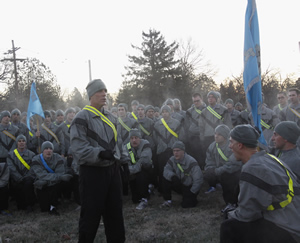
Col.
Jonathan Sweet, commander, 780th Military Intelligence Brigade,
addresses his troops following their first official brigade run,
conducted Dec. 2, 2011, following the unit's activation ceremony, which
was held Dec. 1, at Friedman Auditorium, Fort George G. Meade, Md.
Photo: U.S. Army by Tina Miles
Considering that the internet made its first public appearance not long ago, in the 1980s, it is astonishing how fast we have arrived at “Star Trek” like enemy computer attack events. Was Lt. Uhura, originally a communications officer from a 1960 television program, the precursor of the current C4ISR expert and cyber soldier? In Star Trek, due to her technical and computing capabilities, she proved indispensable in most of the episodes against sophisticated and complex enemies who mostly used malware or mechanical or robotic intelligence to attack the Federation allies. If we look at literature and films from the 1940s and on, man has always been fascinated with the power of computers against man. Current real life warfare pits man against man with the added advantage of computer war in Cyberspace.
The origin of the word “Cyberspace” is cybernetics and space. There, however, is no uniform definition. One pictures a space composed of electronic data or electric nerve-like impulses. The cyber soldier exists in this complex battlefield, where the enemy is everywhere and nowhere, and he/she is trained to navigate, understand, manipulate and control the data and anticipate the enemy so that the traditional armed forces can operate.
The ultimate goal of the cyber soldier is proactive or reactive but the intention is to prevent loss of combat advantage and avert serious personal injury or death. So while the 780 brigade cyber soldier, like his/her parallel in other countries, may be a geek, he or she is actually a specially hand-picked, meticulously trained, elite warrior who will be charged with defending his country and their allies from forceful threats in the intricate, labyrinth of Cyberspace. Military culture must adapt to this new reality where blood spill is real and nothing can be taken for granted from now on.
About the author: Lori Solberg (MBA, Adv.)
Former deputy general counsel of Rafael Advanced Defense Systems (international), Lori Solberg provides customized general and business advice to advanced technology and defense companies. She specializes in business market expansion in the defense and HLS fields worldwide as well as representation before international export control authorities.
Cheongung – a New MR-SAM for the South Korean Multi-Tier Defense System
The growing threat of missile attack by North Korea has concerned
Seoul for decades, but only recently defensive systems are showing
progress, with interceptor technology becoming available on the domestic
and world market. Last week the Agency for Defense Development (ADD) of
South Korea unveiled the Cheongung – a new medium-range Surface to air
Missile system designed to beef up the country’s air and missile
defense.
Missiles deployed by North Korea are covering the entire area
of the South, Pyongyang has deployed more than 600 short-range Scud
missiles north of the Demilitarized Zone (DMZ), with a range of 320 to
500 kilometers. In addition, 200 Rodong missiles positioned inland have a
range of 1,300 kilometers, reaching every point in the South. North
Korean Intermediate range ballistic missiles can also reach Russia,
China, Japan and Alaska.
Until recently Seoul relied primarily on
the U.S. air defense umbrella, comprising Raytheon’s latest version
MIM-23 Hawk XXI and ex-German MIM-104 Patriot PAC-2 missiles. Air and
missile defense is augmented by the Navy’s AEGIS cruisers and
destroyers, providing ad-hoc anti-missile defense.
To defend
against North Korean missiles and rocket attacks the Republic of Korea
is eying a three-tier aerial and missile defense system to integrate
radars, missile interceptors of different types through a unified battle
management system. Preliminary study on missile shield system to be
completed by year-end.
Seoul principal air defense layer operates
six batteries of Patriot PAC-2 GEM/T missiles along with 24 Hawk XXI
batteries. These assets are more capable to defend against aircraft than
hit ballistic missiles. Two missile interceptor/air defense programs
currently underway in Russia will be transferred for production in
Korea, one covering extended range and high altitude, and another
handling the middle-tier zone.
The first is the medium-range air
defense system known as KM-SAM, developed in Russia by the Almaz Design
Bureau, in association with an industry team from Korea lead by Samsung
Thales. This team included missile builder LIG Nex1 and platform
manufacturer Doosan DST. Further localization and industrialization were
done in South Korea, making the new weapon system
an indigenous program.
 The
new SAM called ‘Cheongung’ (Iron Hawk) can intercept targets at
altitude up to 15 km and at a range of about 40 km. LIG Nex1 plans to
begin production in 2012 and according to the original schedule, begin
replacing the first MIM-23 Hawk batteries beginning 2013. Following the
induction of the new Cheongung Seoul plans to offer the missile for
export. Seoul estimates the market potential of such missiles at over
US$2.3 billion. Apparently, the Russian Company that developed the
system, Almaz Antey, thought the same as they kept the program alive
after transferring the prototypes to Korea. The Russian version known
as Vityaz could be ready to replace first generation S-300PS (5V55R)
missiles, covering a similar intercept envelope, by the end of their
service in 2015.
A Cheongung battery comprises a fire control
center, a multi-function radar and up to eight fire units, each carrying
eight missiles in ready to launch configuration. It is designed to
engage multiple targets simultaneously while tracking (hundred?)
additional targets. The key for this capability are the compact
multi-function radar developed by Thales-Samsung. Target data and
intercept commands are transferred to the missile just prior to firing,
with mid-course updates relayed in flight. The vertically launched
missile is designed for high maneuverability withstanding loads of up to
50g. It weighs 400 kg, and uses INS guidance with midcourse updates,
with active-homing RF seeker for terminal guidance. The multi-function
radar is a 3D plannar active array system operating in the X band, it
rotates at a rate of 40 rpm and covers up to 80 degrees in elevation.
The
upper tier interceptor will be designed intercept ballistic missiles,
offering capabilities similar to the American THAAD missile. This new
missile is expected to be based on the Russian S-400 technology; it is
designated Cheolmae 4-H, and will offer a range of 150 km and ceiling of
about 200,000 ft, offering performance levels twice superior to the
Patriot and future Cheolmae II missiles. This project is expected to
cost around $812 million.
The Korean Navy is also planning to deploy
anti-ballistic missile capability on its new KDX AEGIS destroyers.
Unlike Tokyo, that has entered the U.S. SM-3 ABM program as a
development partner, Seoul preferred to go its own way and develop its
won version of a missile interceptor under ‘Project Guardian’, at an
investment of about US$1 billion.
The baseline for Seoul’s future
the missile defense capability are two EL/M-2080 ‘Super Green Pine’
radars, ordered from Israel’s IAI Elta in 2009. The radars will be able
to detect hostile missiles 800 km away, providing missile defense assets
ample early warning for response. These radars will also integrate with
the SPY-1 radars of the AEGIS KDX destroyers to provide the situational
picture for the Korea Air and Missile Defense center (KAMD) beginning
next year.
Until recently Seoul relied primarily on the U.S. air defense umbrella, comprising Raytheon’s latest version MIM-23 Hawk XXI and ex-German MIM-104 Patriot PAC-2 missiles. Air and missile defense is augmented by the Navy’s AEGIS cruisers and destroyers, providing ad-hoc anti-missile defense.
To defend against North Korean missiles and rocket attacks the Republic of Korea is eying a three-tier aerial and missile defense system to integrate radars, missile interceptors of different types through a unified battle management system. Preliminary study on missile shield system to be completed by year-end.
Seoul principal air defense layer operates six batteries of Patriot PAC-2 GEM/T missiles along with 24 Hawk XXI batteries. These assets are more capable to defend against aircraft than hit ballistic missiles. Two missile interceptor/air defense programs currently underway in Russia will be transferred for production in Korea, one covering extended range and high altitude, and another handling the middle-tier zone.
The first is the medium-range air defense system known as KM-SAM, developed in Russia by the Almaz Design Bureau, in association with an industry team from Korea lead by Samsung Thales. This team included missile builder LIG Nex1 and platform manufacturer Doosan DST. Further localization and industrialization were done in South Korea, making the new weapon system an indigenous program.
 The
new SAM called ‘Cheongung’ (Iron Hawk) can intercept targets at
altitude up to 15 km and at a range of about 40 km. LIG Nex1 plans to
begin production in 2012 and according to the original schedule, begin
replacing the first MIM-23 Hawk batteries beginning 2013. Following the
induction of the new Cheongung Seoul plans to offer the missile for
export. Seoul estimates the market potential of such missiles at over
US$2.3 billion. Apparently, the Russian Company that developed the
system, Almaz Antey, thought the same as they kept the program alive
after transferring the prototypes to Korea. The Russian version known
as Vityaz could be ready to replace first generation S-300PS (5V55R)
missiles, covering a similar intercept envelope, by the end of their
service in 2015.
A Cheongung battery comprises a fire control center, a multi-function radar and up to eight fire units, each carrying eight missiles in ready to launch configuration. It is designed to engage multiple targets simultaneously while tracking (hundred?) additional targets. The key for this capability are the compact multi-function radar developed by Thales-Samsung. Target data and intercept commands are transferred to the missile just prior to firing, with mid-course updates relayed in flight. The vertically launched missile is designed for high maneuverability withstanding loads of up to 50g. It weighs 400 kg, and uses INS guidance with midcourse updates, with active-homing RF seeker for terminal guidance. The multi-function radar is a 3D plannar active array system operating in the X band, it rotates at a rate of 40 rpm and covers up to 80 degrees in elevation.
The upper tier interceptor will be designed intercept ballistic missiles, offering capabilities similar to the American THAAD missile. This new missile is expected to be based on the Russian S-400 technology; it is designated Cheolmae 4-H, and will offer a range of 150 km and ceiling of about 200,000 ft, offering performance levels twice superior to the Patriot and future Cheolmae II missiles. This project is expected to cost around $812 million.
The Korean Navy is also planning to deploy anti-ballistic missile capability on its new KDX AEGIS destroyers. Unlike Tokyo, that has entered the U.S. SM-3 ABM program as a development partner, Seoul preferred to go its own way and develop its won version of a missile interceptor under ‘Project Guardian’, at an investment of about US$1 billion.
The baseline for Seoul’s future the missile defense capability are two EL/M-2080 ‘Super Green Pine’ radars, ordered from Israel’s IAI Elta in 2009. The radars will be able to detect hostile missiles 800 km away, providing missile defense assets ample early warning for response. These radars will also integrate with the SPY-1 radars of the AEGIS KDX destroyers to provide the situational picture for the Korea Air and Missile Defense center (KAMD) beginning next year.
Indian Air Force Opts for More Su-30MKI, Despite Problems
Despite recent the recent crash of a Su-30MKI, Indian Air Force stands behind its first line strike fighter, increasing the planned fleet to 272 aircraft. An order for 42 additional planes was signed yesterday (December 16, 2011) in Moscow, by Defence Secretary Shashi Kant Sharma and Russian Federal Service for Military-technical Cooperation Director MA Dmitriev. India received the first of 120 Su-30MKI fighters in 1997. Follow-on orders have increased the number to 230. The new fighters will be the first newly upgraded models of the Su-30 MKI, provided with upgraded radar, enhanced cockpit displays and avionics, and designed to carry heavier loads, including the air-launched version of the Brahmos supersonic air-to-surface missile.

The AL-31FP turbofan engine of the Su-30 MKI that crashed this week
Until
December 2011 the Su-30 MKI fleet demonstrated high reliability and
safety record despite two crashes – both in 2009, that were attributed
to pilot error (the pilot inadvertently switched-off the fly-by-wire
aircraft, the switch was placed behind the seat, clearly a design error
that claimed the lives of the two men crew). The second crash was
attributed to a foreign object ingestion.
The third crash that occurred December 13, 2011 raised for the first time a concern about the safety of the flight control system. Although there were minor incidents with the Su-30 MKI ‘fly by wire‘ system in the past, none was ended in a crash. The recent crash was different. The aircraft was relatively new, among those built by HAL India in 2009. It was on the first flight following mandatory periodical check (400 flight hours). The system gave no indication about the fault, but controls deteriorated as the plane entered oscillation that evolved and worsened over almost 20 minutes, as the pilot, Wing Commander GS Sohal fought to keep the aircraft flying. Realizing the plane was losing control, WC Sohal and his weapon system operator, Flight Lieutenant U Nautiyal ejected, sending the plane to crash near a village of Wade Bolhai. Russian manufacturer is sending an expert team to investigate the accident and come up with the necessary fixes. The cause of the first accident in 2009 was attributed to a misplacement of a critical switch.
According to sources, in October 2009, one such fighter, participating in Air Force Day fly past over Hindon, UP, got a warning of ‘fly-by-wire’ after takeoff. Immediately, the controls became “sluggish” and it started “pitching up”.
A similar incident that luckily ended safely was reported in October 2009, a month after the first crash. “During recovery and the most critical part of a flight – approach and landing – it experienced continuous oscillations, and was pitching up viciously, nearly uncontrollable,” the Sunday Standard reported, “Post-flight inspection revealed multiple failures of the ‘fly-by-wire’ system, whose quadruple redundancy backs up all parts four times, making it difficult for all to fail at once. With avionics of non-Russian origin, the Su-30MKI has been facing integration problems from the beginning.”
 Following
the mishape all 120 Su-30 MKI in five bases (Pune, Bareilly, Tezpur,
Chabua and Jodhpur) were grounded, limited operations are to resume by
Monday December 19, following performing the necessary safety checks.
Another concern surfaced recently is the reliability and serviceability
of the fighters’ AL-31FP thrust-vectored turbofan engines. The engine
powering the Indian fighter is based on the AL-31F turbofan engine
developed by Lyulka (renamed NPO Saturn) in 1981 for the Sukhoi Su-27
(Fencer) fighter. The AL-31FP is a thrust-vectoring variant of that
engine, developed specifically for export Su-30 versions delivered to
India (MKI) and Malaysia (MKM).
The Indian Air Force has elevated the concern of these problems, demanding quick resolution of the issues before the new contract is underway.
The third crash that occurred December 13, 2011 raised for the first time a concern about the safety of the flight control system. Although there were minor incidents with the Su-30 MKI ‘fly by wire‘ system in the past, none was ended in a crash. The recent crash was different. The aircraft was relatively new, among those built by HAL India in 2009. It was on the first flight following mandatory periodical check (400 flight hours). The system gave no indication about the fault, but controls deteriorated as the plane entered oscillation that evolved and worsened over almost 20 minutes, as the pilot, Wing Commander GS Sohal fought to keep the aircraft flying. Realizing the plane was losing control, WC Sohal and his weapon system operator, Flight Lieutenant U Nautiyal ejected, sending the plane to crash near a village of Wade Bolhai. Russian manufacturer is sending an expert team to investigate the accident and come up with the necessary fixes. The cause of the first accident in 2009 was attributed to a misplacement of a critical switch.
According to sources, in October 2009, one such fighter, participating in Air Force Day fly past over Hindon, UP, got a warning of ‘fly-by-wire’ after takeoff. Immediately, the controls became “sluggish” and it started “pitching up”.
A similar incident that luckily ended safely was reported in October 2009, a month after the first crash. “During recovery and the most critical part of a flight – approach and landing – it experienced continuous oscillations, and was pitching up viciously, nearly uncontrollable,” the Sunday Standard reported, “Post-flight inspection revealed multiple failures of the ‘fly-by-wire’ system, whose quadruple redundancy backs up all parts four times, making it difficult for all to fail at once. With avionics of non-Russian origin, the Su-30MKI has been facing integration problems from the beginning.”

Saturn AL-31FP Turbofan engine with thrust vectoring exhaust. Photo: Saturn
The Indian Air Force has elevated the concern of these problems, demanding quick resolution of the issues before the new contract is underway.
Oscillations experienced by a Russian Tu-154 returned to ‘flying condition’ after 10 years in storage.
Israel Air Force Plans Inviting Foreign Air Forces to a Multi-National Air Exercise in 2013
The Israeli and Italian Air Forces on Friday completed a two-week joint training exercise involving fighter jets from both nations. The exercise involved pilots flying F-16A, F-16C and F-15Is from three Israeli squadrons, pitted against Italian Air Force pilots flying Eurofighter Typhoons and Panavia Tornado strike fighters. (Photos: courtesy of Nehemia Gershuni.) This was the second joint exercise the Italian Air Force is conducting with the Israel Air Force in the IAF Airbase in Ovda, near Eilat, flying over the Israeli air/ground and air/air training range in the southern Negev desert. A similar exercise took place two months ago at the Italian Air Force at the Decimomannu Airbase in Sardinia.
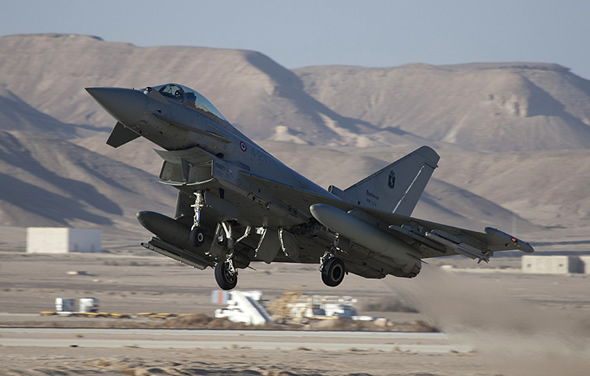
Italian
Air Force Typhoon takes off from IAF Base Ovda. The aircraft carries
two IRIS-T air/air missiles. Photo: Nehemia Gershuni, www.ngphoto.biz
Israel operates an aggressor squadron flying F-16s from the base in Ovda. For the recent exercise the squadron doubled the number of aircraft operated against the visiting aircraft, adding F-15I and F-16C fighter planes from northern IAF bases. A large instrumented combat range located north of the base is scattered with targets simulating active surface-to-air missile sites, radar emitters and electronic warfare threats realistically represented surface based threats and targets, offering modern strike fighters an excellent training environment.
The exchange is beneficial for the Israel Air Force as it offers the Israeli opportunities an important opportunity to train in dissimilar air combat, against unfamiliar combat aircraft they could meet at war. It also opens vast and unfamiliar training areas for the Israeli pilots, in neighboring countries, offering the Israeli pilots realistic and challenging missions at extended ranges – missions they canot perform realistically over their small home land.
For foreign air forces the training in Israel and with the reputable Israel Air Force provides an opportunity for pilots to gain unique experience in more realistic combat conditions they are used to in their training areas, particularly concerning electronic combat, self protection and engagement of surface-to-air weapons.

An Italian Air Force (ITAF) Eurofighter Typhoon takes off while an Israel Air Force (IAF) F-16C taxi for takeoff from IAF Base
Vision-2020 – The Next Step for India’s Military Space Programs
Indian armed forces are still to get their own dedicated communication and surveillance satellites despite several years of promises and plans. Last week in written reply to a question India’s Defense Minister, A.K.Anthony stated that steps have been taken for providing
a dedicated satellite facility to the armed forces and an Integrated Space Cell has been set up for acquiring space capabilities. During the naval commanders’ conference in 2009, A K Antony had declared that in early 2010 the satellite to boost connectivity over sea would be launched. Subsequently ISRO had revised the satellite’s launch window to December 2010-March 2011, But to no avail. The repeated failures of GSLV (Geosynchronous Satellite Launch Vehicle) and indigenous cryogenic engines are major areas of concern that has bogged India’s space program. ISRO is now left with only one of the cryogenic engines imported from Russia.

Mumbai area seen through the camera of Cartosat 2A. Photo: ISRO
Both these satellites are known to have military uses. CARTOSAT 2A is a robust satellite that offers area specific spot imagery for cartography and the armed forces. It carries a panchromatic camera with spatial resolution better than 1 meter and covers a swath of 9.6 km. Cartosat-2B, has spatial resolution of 2 meters and covers a swath of 30 km. per camera. For the purpose of anti submarine warfare and bathymetric studies the Indian Navy can access data from the OCEANSAT 2 satellite.
As a knee jerk reaction to the Mumbai terrorist attacks in December 2008 ISRO launched the RISAT 2, which it purchased off the shelf from Israel Aerospace Industries. Data collected by the RISAT 2 is primarily used by the National Technical Research Organization (NTRO), which controls satellite with the Military. RISAT 2 also has the unique distinction of being India’s first satellite with a Synthetic Aperture Radar (SAR), which provides night and all-weather surveillance. (The Video above is describing the Israeli EL/M-2070 SAR system used in this satellite.) It is expected that by 2014 the $25 million indigenously developed Communication-Centric Intelligence Satellite (CCI-Sat) that is being developed by the Defense Electronics and Research Laboratory under the Defense Research and Development Organization will become operational.

The
newly completed GLONASS constellation could enhance the planned IRNSS
Indian Regional Navigation Satellite System yet to be deployed. Photo:
Reshetnev
The military and civil need for a countrywide GPS and associated applications is also upsetting India’s space program. A deal with Russia on its Global Navigation Satellite System (Glonass) satellites would mean easy access to the constellation.

The Indian Space Research Organization (ISRO) GSLV heavy satellite launcher
The constellation and ground support will be ready by 2014. Three satellites will be in geostationary orbit (34, 83 and 132 deg. E. Long.) over the Indian Ocean. Missile targeting could be an important military application for the constellation. The IRNSS will offer a customary positioning service and a restricted service, one in the L5 band and the other in S-band. Possibly by 2012 the IRNSS could be incorporated into the Russian Navigation Information System-Glonass system for hybrid applications. However, with no early launch in sight of the GSLV, talk is gaining ground that India should consider a foreign launcher for its GSAT-7 series of military satellites.
About the author: Debajit Sarkar
Debajit Sarkar is an Aerospace and Defense analyst and subject expert specializing in UVS, and smart weapons. In his consulting work Sarkar covered a broad range of international topics, including unmanned aerial systems and autonomous ground systems, 4+/5 Generation Fighters and stealth technology, electronic warfare, radar systems and more. Debajit Sarkar is living in Hyderabad India.
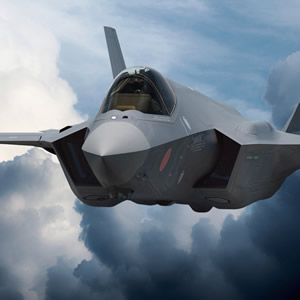
Japan Formally Announces F-35 Selection
Japan formally announced today the selection of the F-35 for its future F-X fighter. Tokyo will receive 42 F-35 Lightning II multirole stealth fighters, to be built by Lockheed Martin, replacing the aging fleet of F-4s, F-2s, and F-15s flying with the Japan Air Self Defense Force (JASDF). It is expected a significant part of the aircraft assembly will be done in Japan, with the country’s leading aerospace industries Mitsubishi Heavy Industries and IHI Corporation having a major role in the production of the aircraft and its engine.Lockheed martin has indicated to offer significant work share to local subcontractors. Japan has considered three options for its F-X program – the Eurofighter Typhoon, an enhanced version of the Boeing F/A-18E/F and the F-35A.
Japan’s Yomiuri newspaper is reporting that Japan will prepare a budget that will include the purchase of four aircraft in 2012 with deliveries tentatively scheduled to begin in 2016. Lockheed Martin confirmed it expects such contract within Japan’s fiscal year 2012 beginning April 2012. The total cost of the acquisition could add up to as much as $8 billion. Although Japan is currently a major air power in the Pacific with some 362 fighters, the aircraft now in operation are suffering from age, overwork, and maintenance challenges. Japanese authorities have been seeking a viable replacement for several years.
Concept vision of the F-35J for Japan
Přihlásit se k odběru:
Příspěvky (Atom)